
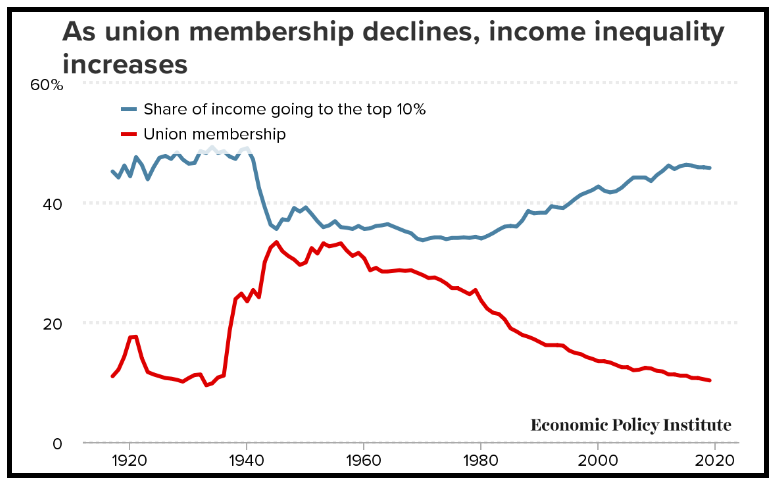
Deniz Kılınç / Istanbul, October 1 (HNA) – Unions improve wages and benefits for all workers, not just union members, while they help reduce income inequality by making sure all Americans, and not just the wealthy elite, share in the benefits of their labour, stated the Economic Policy Institue (EPI).
Unions also reduce racial disparities in wages and raise women’s wages, helping to counteract disparate labour market outcomes by race and gender that result from occupational segregation, discrimination, and other labour market inequities related to structural racism and sexism” said the EPI Fact Sheet and added:
“Finally, unions help win progressive policies at the federal, state, and local levels that benefit all workers. And conversely, where unions are weak, wealthy corporations and their allies are more successful at pushing through policies and legislation that hurt working people. A strong labour movement protects workers, reduces disparities, and strengthens the democracy.”
By bringing workers’ collective power to the bargaining table, unions are able to win better wages and benefits for working people—reducing income inequality as a result, according to EPI, “There was less income inequality in the decades following World War II than there is today. Not coincidentally, union membership was at its highest rate in 1945, just as the war was ending. But as union strength steadily declined—particularly after 1979—income inequality got worse, and it is now at its worst point since the Great Depression.”
Deunionization depressed the wages of middle-wage earners but had little impact on high-wage earners and therefore greatly increased wage inequality between these two groups, stressed the EPI, “For instance, deunionization explains a third of the growth of the wage gap between high- and middle-wage earners over the 1979–2017 period.”
The erosion of collective bargaining is the second largest factor that suppressed wage growth and fueled wage inequality over the last four decades—only excessive unemployment had a larger impact, reminded the EPI, and went on as follows:
“When unions are strong, they set wage standards for entire industries and occupations; they make wages more equal within occupations, and they close pay gaps between white workers and workers of colour. The reasons unions are such a major force for equality are set out more fully below.
“While union workers receive higher wages than nonunion workers, nonunion workers also benefit immensely from the presence of unions. This raises wages for working people and reduces wage inequality. We explain below.
“Union workers earn more than nonunion workers. On average, a worker covered by a union contract earns 10.2 percent more in hourly wages than someone with similar education, occupation, and experience in a nonunionized workplace in the same sector.”