
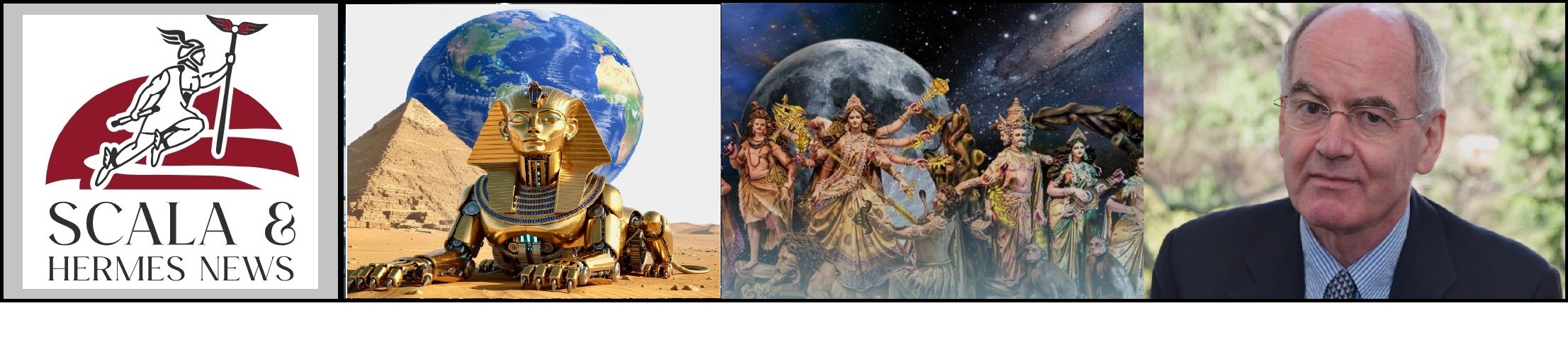
John Elkington
In 2001, the Taliban shocked the world by destroying Afghanistan’s Buddhas of Bamiyan. Those statues were around 1,400 years old—so who knows what fate ultimately awaits the Great Sphinx of Giza, now some 4,500 years old?
If it ever had to be recreated, though, the task would be staggering. Carved from a single limestone outcrop, the Sphinx stretches roughly 73 meters long and rises 20 meters high. Standing before it yesterday morning, the thought train rattled through my brain.
And yet I found myself concluding that, whatever happens physically, the symbol itself is now indelibly etched into human memory. Which raises a deeper question: what will the Sphinx symbolise in the future?
In effect, the Sphinx is the “deep tech” of a long-lost civilisation—one devoted to ensuring that elite figures reached the afterlife with the minimum of hassle along the way, while those who built these monuments laboured under the hope that they, too, might one day live forever.
For its time, this was every bit as complex as today’s Silicon Valley: tightly guarded chemistries for mummification, secret spells, and elaborate inscriptions carved and painted in and around pyramids and underground tombs.
With no sense of irony, today’s tech elite pursue similar ambitions, albeit by other means. Jeff Bezos has invested in Altos Labs and Unity Biotechnology; Sam Altman backs Retro Biosciences; Peter Thiel supports the Methuselah Foundation, Unity Biotechnology, and explores cryonics; and Google co-founders Larry Page and Sergey Brin fund Calico Labs, focused on neurodegenerative disease.
The tools may have changed, but the aspiration—radical longevity—has not.
The symbolism of the Great Sphinx of Giza is layered and still evolving. True to the spirit of ancient Egypt, it can rarely be pinned to a single interpretation. What we do know comes from archaeology, including the interpretation of inscriptions and later texts, as we struggle t decode long-ago ideas about power, nature, and the cosmos.
The Sphinx’s form alone speaks volumes: the body of a lion, symbolising strength and guardianship, joined to a human head representing intelligence, authority, and divine kingship. The fusion was probably designed to present the pharaoh as both a human ruler and a cosmic force—embodying nature’s most potent qualities rather than standing apart from them.
The creature also faces east, toward the rising sun, as it guards the Giza necropolis. In Egyptian thought, thresholds mattered—between life and death, chaos and order, the human and the divine. It is thought that the Sphinx functioned as a liminal guardian, protecting sacred ground and maintaining the cosmic balance.
By the New Kingdom era, it was closely associated with the sun god, known as Horemakhet (“Horus of the Horizon”), and so linked to rebirth, renewal, and cyclical time—in short, regeneration.
The Dream Stele of Thutmose IV, placed between the paws of the Sphinx, reinforces this idea: it seems to promise care in exchange for kingship and control. So perhaps it was seen as a listening and even responsive presence, not simply as a mute monument.
Was “lastingness” the original sustainability?
Carved directly from bedrock rather than assembled stone by stone, it feels less constructed than “emerged.” And, symbolically, that matters. It blurs the boundary between the monument and the wider landscape, suggesting continuity across dynasties, and embodying Egypt’s deep, long-lasting obsession with what some call “lastingness.”
While the pyramids still strain upward, the Sphinx remains poised—watching time and civilisations pass. Its reputation as a riddle-keeper came later, largely through the invading Greeks, who saw it as an enigma: a guardian of hidden knowledge.
Seen through a sustainability lens, though, maybe today’s Sphinx is neither a symbol of hope nor of doom, but of reckoning. It has witnessed civilisations rise and fall, reminding us that today’s sustainability challenges are not simply technical, but ultimately civilizational.
The brooding figure can be seen as standing for geological time rather than quarterly earnings, for planetary boundaries rather than market cycles, and perhaps also irreversible damage versus decisions that cannot be undone. Unlike Silicon Valley, which rewards relentless expansion, the Sphinx suggests limits, however creative we are.
In my mind, it also poses uncomfortable questions, such as: What must not be optimised? What cannot be scaled? What breaks once and never returns?
More positively, with its human head and animal body, it represents an intelligence that integrates rather than fragments. That is precisely what sustainability demands: aligning ecological with economic thinking, scientific data with cultural meaning, and global coordination with local stewardship.
Our many interlocking crises persist because we optimise parts while destabilising wholes. The Sphinx, by contrast, symbolises systems-level wisdom. And it invites a longer set of questions—not What grows fastest? Or what delivers the highest return? But what deserves to last? What can persist across generations? What future humans would thank us for?
The economic order now surfacing all around us poses a set challenge no previous system faced. Among them, the question of how to create value when intelligence, creativity, and coordination are no longer scarce. As new forms of AI erode labour position—and power—as the primary source of value, productivity measured in a single, financial dimension remains a shaky proxy for long-term prosperity.
Perhaps, then, tomorrow’s Sphinx may come to symbolise the constant need to guard the conditions necessary for a truly regenerative economy—one that values the afterlives of all living things, not just of humans and their elites. The sort of economy, in fact, is detailed by John Fullerton in his book Regenerative Economics, which I read again on our flight to Cairo a couple of days ago.
Ultimately, the Sphinx might even come to symbolise the riddles posed by the human urge to find the secrets of immortality and, more parochially, forms of sustainable value creation that can succeed under conditions of abundance, automation, and planetary limits.