
Osman Şenkul
Al Capone (Alphonse Gabriel Capone), the co-founder and boss of the infamous Chicago Outfit crime syndicate, was born in New York in 1899 to an Italian immigrant family. As a young man, Al Capone joined the Five Points Gang and served as a hitman in numerous organised crime establishments. Years later, Al Capone, who was the subject of many Hollywood films, moved to Chicago in his early twenties and became the bodyguard of Johnny Torrio, the head of a crime syndicate that supplied illegal alcohol, and was politically protected through the Italian-American National Union (Unione Siciliana). Known by many at the time as ‘the Robin Hood of our day’ for his donations to various charities, Al Capone was referred to in newspapers as ‘Public Enemy Number One’ as a result of his attacks in many places. Al Capone, also known by the nickname “Scarface,” saw his seven-year reign as a mafia leader come to an end when he was imprisoned at the age of 33.
Soeren C. Schwuchow from the Department of Economics at Brandenburg University of Technology in Germany Schwuchow from the Department of Economics at Brandenburg University of Technology in Germany emphasises in his articles published in the European Journal of Law and Economics in 2023 that he and his colleagues are working on a model that provides a new theoretical justification for the empirically well-documented relationship between “poverty, inequality and corruption”.
After providing information about Al Capone’s life in the introduction to the article, it states, “At the height of Al Capone’s reign, on 17 October 1931, he was found guilty of tax evasion and sentenced to eleven years in prison a week later. It is a well-known fact that Al Capone was convicted of tax evasion (rather than, perhaps, the many murders he ordered); however, two other noteworthy aspects of his conviction are also worth mentioning,” it states, adding:
“First, the investigations that ultimately led to the court ruling were mostly conducted by federal law enforcement agencies, because local authorities had become completely corrupt due to Al Capone’s large-scale bribery (Richman & Stuntz, 2005).
“Second, Capone’s conviction, which marked the beginning of his decline, occurred before the onset of the Great Depression, which led to economic recession but also caused a significant reduction in inequality. While it is impossible to determine whether this timing was merely coincidental, it should be noted that the American mafia generally declined similarly.”
According to the article, which states that ‘the American Mafia primarily provided protection for the (criminal) activities of others, its main asset being its extensive network of connections with urban political mechanisms and the significant influence this brought in local and city politics,’ the Mafia, which reached the peak of its power and influence in the mid-1950s, became a victim of its own success, which increased interest in its activities. The problem of organised crime was subsequently brought to the political agenda, and from early 1961 onwards, the US federal government launched a “nationwide aggressive offensive” against the Mafia. This development culminated in President John F. Kennedy’s declaration of the “War on Organised Crime” in 1963. With the beginning of the dissolution of the symbiosis (coexistence) between the American Mafia and corrupt local law enforcement and urban political mechanisms, its decline also began.
Later in the article, the following observations are made regarding the concept of “poverty-inequality”:
“According to our model, poverty and inequality can fuel corruption by strengthening organised crime, because in societies with high inequality or weak security forces, the likelihood of collusion between local police forces and criminal organisations is higher. Law enforcement and organised crime have a strong incentive to collude due to the efficiency gains that specialisation brings. However, when mafia members can no longer credibly commit to joint rent maximisation and begin to compete with law enforcement for citizens’ wealth, the agreement between them breaks down.
“Mafia members then monopolise the extortion market by outmanoeuvring police forces, similar to a predatory pricing strategy, without resorting to violence. Criminal collusion is therefore not so different from its institutional counterpart; thus, similar policy measures should be promising. Furthermore, our model also shows that when there is considerable parity in the relative power balance between law enforcement and organised crime, the high efficiency of the criminal organisation in extracting rent has a greater impact. Accordingly, when the predictability of violent conflicts decreases, the non-violent elements of relative power become more important. Our model also allows for the interpretation that combating organised crime is more difficult in situations where there are no strong social norms against corruption.
We are working on a model that provides a new theoretical rationale for the empirically well-documented relationship between inequality, poverty and corruption. According to our model, inequality and poverty can fuel corruption by strengthening organised crime, because in societies with high inequality or weak security forces, the likelihood of collusion between local police forces and criminal organisations is higher. Consequently, due to the resulting efficiency gains, law enforcement and organised crime have a strong incentive to collude.
“However, when mafia members can no longer credibly commit to joint rent maximisation and therefore begin to compete with law enforcement for citizens’ wealth, their collusion breaks down. Mafia members then monopolise the extortion market without resorting to violence, by outbidding the police in a manner similar to predatory pricing strategies. Therefore, criminal collusion is not so different from its institutional equivalent; thus, similar policy measures should be promising.
“Furthermore, our model also shows that when the relative balance of power between law enforcement and organised crime is fairly even, the high efficiency of the criminal organisation in extracting rent has a greater impact. Accordingly, when the predictability of violent conflicts decreases, the non-violent elements of relative power gain greater importance. Our model also allows for the interpretation that combating organised crime is more difficult in situations where there are no strong social norms against corruption.”
As we delved into the details of the article in the European Law and Economics Journal and attempted to analyse it, news about events unfolding in Turkey also began to attract attention. For example, Mahmut Hamsici of the BBC, in his 22 October 2025 article titled “The new generation mafia in Istanbul: What is happening in the neighbourhoods?”, states:
“In the past, when we heard gunshots in the neighbourhood, we would think, ‘Whose wedding is it? Now we think, ‘Which group is shooting at which group?”” Hüseyin, a shopkeeper living in the Zübeyde Hanım neighbourhood in Istanbul’s Sultangazi district, summarises the new situation he has been experiencing for some time with these words. His home is only 100 metres away from his children’s primary school. However, he explains that he now walks his children to and from school every day, holding their hands.
The picture Hüseyin paints is also applicable to other neighbourhoods in Istanbul.
The Barış Boyun and Daltonlar cases related to criminal organisations reveal that groups referred to as the ‘new generation mafia’ are operating intensively in Turkey, particularly in Istanbul. We investigated the conditions under which these groups emerged, how they influence young people, and how they transform life in neighbourhoods across different districts of Istanbul.
Tekin, a resident of the Bahçelievler Yenibosna neighbourhood in his 50s, says that his business dealings in the past gave him the opportunity to ‘observe’ traditional mafia groups, and now he sees young people in his neighbourhood joining new groups. ‘I’ve never seen Istanbul so criminal,’ he says. One of the groups that witnesses this situation the most is shopkeepers. In fact, shopkeepers play an important role among the complainants in cases involving such groups.
According to the indictments, in some neighbourhoods, these groups demand money from businesses by force, using phrases such as ‘protection money, street rights, fines, and convict money’. If they don’t get it, helmeted attackers on motorcycles can open fire on the businesses.
According to Ekber, who runs a textile workshop in Gazi Mahallesi, loan sharking is also very common in the area, and when debts are not collected on time, guns can go off. Haydar, a respected local tradesman from the same neighbourhood, says, “There’s a new situation in the neighbourhood now,” adding, “Recently, tradesmen have started calling the police and keeping them waiting outside their shops for fear that ‘they’ll come’.”
Tekin from Yenibosna shares a different observation on this matter: “Of course, there are cases where they bother ordinary shopkeepers, but some of the shopkeepers they target are men who are involved in illegal activities or who have a lot of money. They go to them and say, ‘Since you’re doing this, you’ll give us a share.'”
There are also frequent clashes between criminal organisations. Ekber illustrates the impact this has on them with examples: ‘Recently, in a clash, a bullet hit a shop belonging to someone in my family, shattering the windows. These incidents have become so frequent that there’s a café near Heykel Square that constantly has to replace its windows.’
Berna, who lives in Esenyurt and works for a private company, explains that she recently intended to open a restaurant with her family, but gave up when a friend, looking for a shop in the area, said, ‘What shop? They recently raided the famous baklava shop there.’
Why interest in these ‘new generation’ groups has increased is one of the most discussed topics of recent times. In our interviews in different neighbourhoods, almost everyone agreed that economic problems play a significant role in this. Özge, a 23-year-old university graduate looking for work who lives in Kağıthane, summarises the situation as follows: “It’s no coincidence that all of them come from low-income neighbourhoods.” Özge then goes on to mention ‘the inadequacy of education in the neighbourhoods, the overcrowded classrooms and the prevalence of peer bullying.’
According to Tekin from Yenibosna, poverty is important in the growth of these groups and the increase in participation in them, but it is not a sufficient reason on its own: ‘After all, poverty is not a new thing. What is different about this period is the drug issue, which I think is very important. There is also the desire to leave the country. And there is no such thing as morality anymore.’
Tekin elaborates on his concern about ‘morals’ as follows: ‘There used to be a code of conduct in these matters, but that’s gone now. They can execute a man in front of his pregnant wife. There are no principles left.’ Tekin also says that obtaining weapons has become much easier: “Now, for example, CNC weapons made in back rooms are widespread. They don’t last very long, but they get the job done.”
Özge from Kağıthane, while explaining young people’s interest in these groups, draws attention to the differences between generations: “As Generation Z, we are at a point where, even if we work hard, we will not be able to afford a house or a car like the older generations. So some people say, “We won’t get anything anyway,” and spend their money on clothes, accessories, and holidays. Others want to make money the easy way.
Özge argues that the motivation for ’quick money‘ is a factor in the appeal of these groups, giving an example from her circle of female friends: ’OnlyFans is incredibly widespread. Many of my friends are on it. When I talk to them, they say, “What’s the big deal?”
On the UK-based OnlyFans site, content creators share personalised sexual content and receive money in return.
In the Cumhuriyet newspaper, an article published on 23 October entitled “Daltons, Casper, Redkit, Ugly, Cute… Impressions from the neighbourhoods of the new generation of gangs!‘ states, ’While there has been a noticeable rise in murders and armed crimes committed on motorcycles in Istanbul in recent years, the number of armed gangs, referred to as the “new generation of gangs” and consisting mostly of young people, even children under the age of 18, has increased rapidly. Striking observations from the neighbourhoods dominated by these groups, known by names such as the Daltons, the Casper, the Redkits, the Ugly Ones, and the Cute Ones…”
When we meet Cüneyt, who grew up in the Piripaşa neighbourhood of Beyoğlu and now works in a café, he tells us the story of two old friends who got involved with these kinds of groups. In the first story, Cüneyt’s friend is still alive:
“We were in secondary school together. He dropped out. He started working in a clothing factory. He started using drugs while hanging out with the neighbourhood big brothers. He started dealing drugs. He rented a flat. He bought a car. He was going to the escorts. Then he started working as a hitman. That’s when we lost touch. The guy shot, got shot, went to prison. He rose quite high in that world.‘
Cüneyt believes the family also bears responsibility in this process: ’When my friend brought money home, his mother and father didn’t ask him, “Where did you get so much money at your age?”. He bought his family a house, and the family became even happier.”
Cüneyt tells us that his friend from the second story died: “He was another high school friend of mine. After finishing school, he started getting involved in petty crime in the neighbourhood. He gathered a group of men around him. Then he got involved with some higher-ups. We lost touch during that period. There was a café in Haliç, and he started running it. A rival group told one of the girls he was seeing, “We’ll give you money, tell us where he is”. The girl sent them his location. They came and killed the lad in his own place.”
Ahmet from Kağıthane recounts how, as a child, he was often teased, and how a younger friend of his joined one of these groups, was injured in a fight, and went in and out of prison. Ahmet, who says they still see each other, says, ‘Even though he’s in that world, when we get together, he seems perfectly normal in a strange way. We never talk about these things.’
Again, in Cumhuriyet’s report, according to the 2025 Drug Report published by the General Directorate of Security on 16 October, it is noted that in 2024, the seizure rate of drugs known as ‘synthetic drugs’ increased by 227 per cent compared to the previous year, stating: ‘The number of deaths due to drugs rose by 42%, while the number of drug-related suspects increased by 20% to 374,948.’
According to the people we spoke to, access to drugs in neighbourhoods has become easier than ever, partly due to mobile phone applications.
Ekber from Gazi Mahallesi explains that drugs are now mostly sold by teams on motorcycles in his neighbourhood and adds: “They’ve even started selling to young girls to avoid detection.”
According to what we were told in the neighbourhoods, a drug called ‘peçete’ (tissue) has been spreading rapidly recently. Many groups are mentioned in the neighbourhoods, but the name we encounter most often is ‘Daltonlar’ (the Daltons). According to Tekin from Yenibosna, there are actually many more groups: “There are many groups in Istanbul that operate quietly, don’t use social media, and are perhaps smaller in scale. Illegal activities are everywhere.”
Comparing what he has observed with past criminal organisations, Tekin describes how today’s youth perceive this world: “Young people see it as a game. You’ve taken a life, you’ve given a life. There’s no turning back. They live as if they’ll never die.”
He then adds, “In the end, you’re finished. You’re either in a coffin or in prison.”
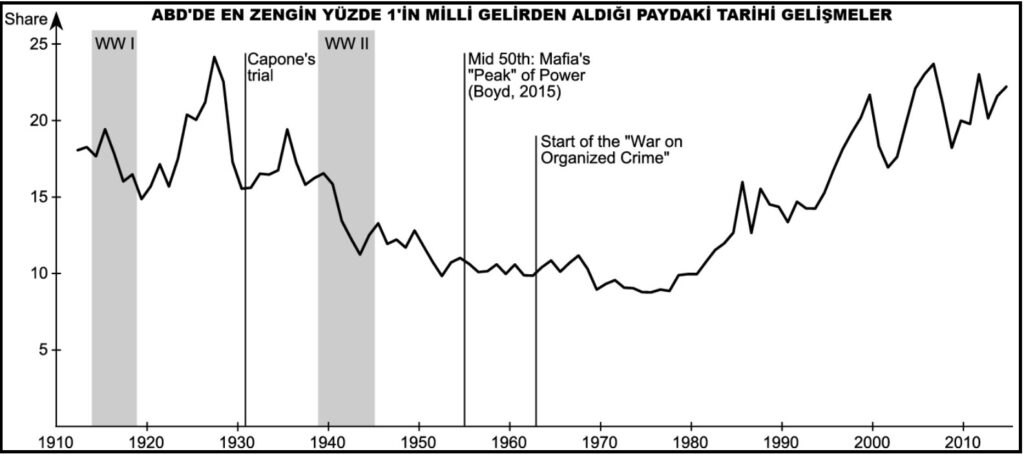
What you have read so far, as I mentioned above, largely consists of translations from an article published in the European Law and Economics Journal and excerpts from news reports published by the BBC and Cumhuriyet newspaper. However, the article also includes a graph showing the development of the share of national income received by the richest 1% in the United States between 1913 and 2015, including capital gains. As you will see in the attached graph, during the period when organised crime peaked, including the First World War (WWI) and Second World War (WWII) periods, the share of income received by the top 1% rose significantly, illustrating income inequality. However, after the mafia reached its peak of power in the mid-1950s (Mid 50th: Mafia’s Peak of Power) and following the Start of the War on Organised Crime in the 1960s, the share of the top 1% fell significantly. However, as can be seen from the graph, this share began to rise again from the 1980s onwards, returning to the peak levels seen between the First and Second World Wars.
According to economists closely monitoring the issue, there is a high level of income inequality in Turkey. The wealthiest segments receive a very large share of total income, while the share of the lower classes is quite low. Although there have been significant increases in nominal income, it is evident that this increase is not felt equally by everyone, and differences in real impact have emerged. According to TÜİK 2024 data, the top 20 per cent income group in Turkey received 48.1 per cent of total income, while the bottom 20 per cent received only 6.3 per cent. According to a report by DİSK-AR, as of 2022, the income of the top 5% income group was approximately 31 times that of the bottom 5% income group. Looking closely at recent developments in Turkey, it is fair to say that the social problems caused by the deterioration in income distribution that the US experienced many years ago are also growing in this country.