
Osman Senkul
The golden age of pirates lasted until the late Ottoman period when they plundered Mediterranean merchant fleets with their boats made of giant cedars from Palestine and Lebanon. After Pericles’ rise to power in Athens, the colonisation of pirates was accelerated by introducing one or more military ships alongside merchant fleets. When the protection of merchant ships was introduced, pirates began to either fail or, even if they could plunder merchant fleets, they were captured until they reached their nearest refuge.
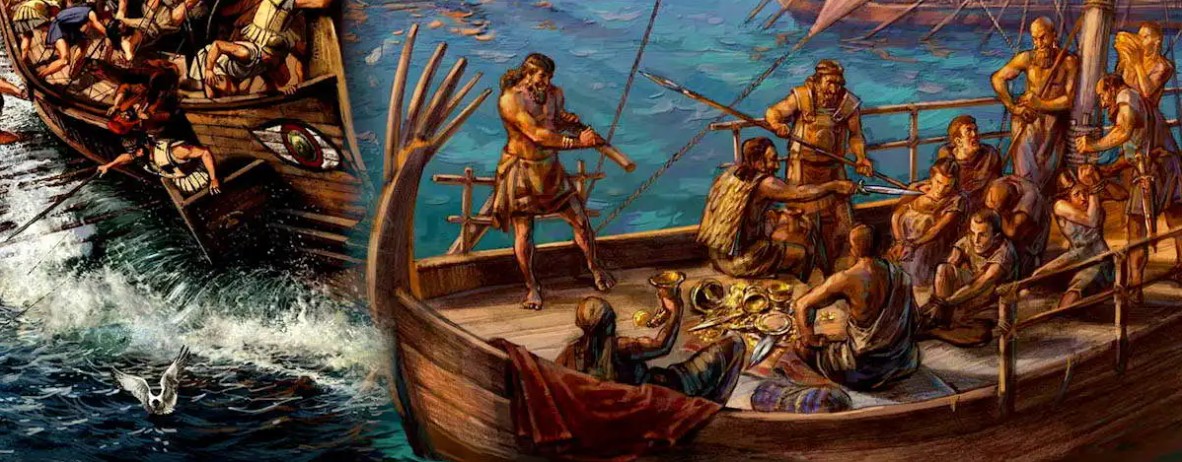
Upon these developments, pirates started to search for bays in Southern Anatolia that could provide safe shelter. During these searches, they found this region with three bays where the city of Phaselis was founded. When viewed from the open sea, this region, which does not give away the ships sheltering in its bays, was very much liked by the Rhodian pirates because of the forest-covered Western Taurus Mountains behind it and because it was also safe from land. They decided to settle here immediately and establish a secure base for themselves.
However, when the pirates landed, they realised the situation would not be as easy as they thought. As soon as they stepped on the land, they were confronted by a shepherd from Anatolia. The shepherd claimed to own the whole region and said he would not allow the pirates to settle there.
The pirates assessed the situation and decided they could not get away with killing the shepherd and seizing the region. Such a move would have led to the tribes on land joining the enemies at sea. Since this situation did not favour the pirates, inexperienced in land wars, they solved the problem peacefully.
The pirate delegation landed again and asked the shepherd to sell the land to them. Since there was no medium of exchange, such as money, at that time, the pirates offered salted fish, which were abundant in their ships and which they met their nutritional needs during long voyages, in exchange for large forested bays. The shepherd, whose job was to raise goats and sheep, said he would accept the salted fish; thereupon, a dark bargain started between the shepherd and the pirates, and finally, an agreement was reached on a certain amount.
The shepherd took the fish that the pirates landed and handed over, took his animals and left the area to them. The pirates, happy to have the territory in exchange for a small amount of fish, said, “We got a very nice shelter “salted (fancy)”, which means “very cheap”. However, the amount of salted fish was a “good price” according to the shepherd. Therefore, the word “salty (fancy)”, which meant “very cheap” to the pirates, represented ‘very expensive’ to the shepherd.
Therefore, from the foundation of Phaselis, this word spread to the islands, especially Rhodes and Crete, and first to Southern Anatolia and then to Anatolia. However, since there were two sides to the exchange, relativism naturally came into play here as well; since the agreed amount of fish represented “cheap” for the Rhodian pirates, the islands “salted” came to be used to indicate the cheapness of something. However, the shepherd had spread the word all over Anatolia that he had sold those useless sheep at a very high price. For this reason, on the Anatolian side, the expression ‘it cost a lot of salt’ has been used to this day in the sense of ‘very expensive’.
The price determined in this transaction was “too salty (fancy)” for both the buyer and the seller, and this ‘too salty’ price made both parties quite happy. This exchange, which took place about 27 centuries ago, has been repeated millions of times, albeit under different conditions. However, nowadays, in almost all exchanges involving two parties, the prices do not have the same ‘salty’ effect on both parties as they did then.
Moreover, since there was no money used and printed and put on the market in those days, there was no determining factor in prices other than ‘need-based bargaining’, and therefore, there was no measurement technique or unit of evaluation such as ‘per cent…’ to reflect the ‘less salty – more salty’ effect of price increases.
Therefore, the new stage we have reached with today’s new techniques has created another factor that now reflects this ‘sense of salinity’ in a fundamentally different way compared to those times, and thus causes fundamentally different perceptions: Price-setters, who experience salinity as Rhodesian-Scythian, and wage-earners, who experience salinity as Anatolian and are obliged to pay the price.
Now, for those who have to pay the price, ‘saltiness’ is measured by the ‘adequacy’ of the wages they receive, and for those who set the price, ‘saltiness’ is measured by the ‘inadequacy’ of the wages they pay.
Therefore, in today’s shopping examples,
– The prices that seem pretty “salty” to those who do not see a grocery store or a market stall, who do not know what an electricity or natural gas bill is, who do not visit fuel stations and do not smell diesel, gasoline or LPG, are based on the Rhodian-Gythian approach of that period,
– The ‘salty’ prices for the millions of people across Turkey who go from grocery store to grocery store in search of bargains and wait in queues for hours to buy discounted meat and cheese correspond to the Anatolian approach of that period.
To analyse the developments in the wages earned and the prices paid with today’s techniques, an example from Turkey can be given as follows:
According to Turkish Statistical Institute (TurkStat) data,
– 5.03 per cent month-on-month and 42.12 percent year-on-year in January
– The monthly and annual price increases of 2.27 percent and 39.05 percent, respectively, in February are at a level that would be considered ‘salty’ for today’s Rhodesian-Gyrians,
According to Inflation Research Group (ENAG) data,
– 8.22 percent monthly and 81.01 percent annually in January
– It is also possible to reveal that the price increases, which were calculated as 3.37 percent monthly and 79.51 percent annually in February, are at a level that can be considered quite ‘salty’ for today’s Anatolians.
The development that added salt to the ‘saltiness’ between islanders and Anatolians came in the middle of the week: First, Istanbul Metropolitan Mayor Ekrem İmamoğlu’s diploma was cancelled, and then he was detained. The repercussions of this major development on the salt shakers were not delayed; first, the Istanbul Stock Exchange crashed, then the foreign currencies skyrocketed, and the three major currencies, the dollar, the euro and the pound sterling, climbed to new record levels. This critical development caused the CBRT to sell approximately 10 billion dollars of foreign exchange. Thus, even though the exchange rates eased slightly due to this sale, they were kept at a certain level higher than at the beginning of the week, keeping a further upward climb in reserve. The most important reflection of this will be that the rise in the prices of many essential products, whose inputs are largely dependent on imports, will be fuelled even faster.
Following these developments means that a significant increase in fuel prices will be achieved in the coming days. As we know, such a development does not only concern car owners; trucks are beginning to carry a heavy price increase along with many food products, especially peppers, tomatoes and cucumbers loaded from the greenhouses on the Mediterranean coast. In addition to vegetables and vegetable roots, precious and semi-precious stones, aeroplanes and spacecraft, iron and steel, machinery, and mechanical parts will also be transported from the new continent. Wheat, soya beans, crude sunflower oil, palm oil and barley, with a combined import value of more than a billion dollars. And, of course, digital technology and other industrial products. Some products offered directly to consumers are also used as inputs/semi-finished products in the manufacturing industry. Since the production costs of these products and semi-domestic products produced using them will increase with the rising foreign exchange rate, their sales prices will also rise, thus fuelling the increase in inflation.
These developments negatively affected Turkey, which has always needed external funding.
According to the statements of JP Morgan, one of the most important institutions in the world financial markets, Turkey’s disinflation programme continues, but the disinflation process may be slower than expected. Due to movements in foreign exchange rates, JP Morgan revised its year-end inflation expectation from 27.2 percent to 29.5 percent and increased its monthly Consumer Price Index (CPI) forecast for March from 2.3 percent to 3.2 percent.
JP Morgan analysts stressed that the Central Bank of the Republic of Turkey (CBRT) is likely to slow the pace of interest rate cuts to 150 basis points from April, and the benchmark interest rate will reach 35 percent at the end of the year. The previous forecast was 30 percent. Analysts also pointed out that the authorities in Turkey will take steps to stabilise the foreign exchange market in the coming days and that the positions regarding the local markets have not been changed.
Following this development, the US-based giant investment bank Morgan Stanley voluntarily cancelled its stock exchange membership in Borsa Istanbul. In the notification made by Borsa Istanbul A.Ş. to the Public Disclosure Platform (PDP) on 19 March 2025, the following statements were used:
“Morgan Stanley Menkul Değerler A.Ş. (Member Code: MSI), whose application to completely waive its operating permits was approved by the Capital Markets Board and whose Narrow Authorized Intermediary Institution Certificate was cancelled, was removed from the membership of the Exchange by the decision of the Board of Directors of the Exchange dated 12/03/2025.”
In short, while combating inflation has begun, neither 24 per cent nor 34 per cent can be mentioned anymore. Borrowing from abroad will become more complicated; the exchange rate increase will make it difficult for debtor companies, and thus, costs will rise even more. Suppose wages, one of the main factors determining the salinity of prices for both sides, do not increase in parallel with the increase in salinity. In that case, they will rise to levels high enough to make Anatolians suffer from hypertension and to fill the warehouses of Rhodes-Gyrians to the brim with ‘salted fish’. As can be seen from this, the salt created by today’s policies is increasing so much that it fills only the salt shakers of some and the ‘storehouses of wealth’ of others.
From this point of view, before the latest development, among the comments on how the rate of saltiness in prices is expected to evolve, ‘The decline in inflation after February will be slower due to the base effect’ was prominent. Still, as long as policies that suppress wages by saying ‘Inflation will fall in the coming period anyway’ come to the fore, tensions among wage earners, whose salt shakers will be filled, will rise and rise.