

Osman Şenkul
Pericles (495–429 BC), regarded as one of Ancient Greece’s most powerful statesmen, was trained to become a skilled politician through lessons he received in his childhood from Anaxagoras, Damon and Zeno. Entering political life at the age of thirty, Pericles was elected head of government (Archon) from the democratic faction in the elections of 461 BC, and in 444 BC he eliminated the opposition and proclaimed himself head of state. Upon becoming head of state in Athens, Pericles implemented reforms across the country, enacting new laws to create a system that shifted the tax burden onto the wealthy. He had Athens rebuilt from scratch, adorned it with numerous new artistic and architectural works, and gathered Greece’s most renowned scholars to Athens.
Before Pericles, merchant ships would set sail into the Mediterranean in large fleets; when attacked by pirates, the shipowners would voluntarily hand over a specific amount of goods they had collected amongst themselves as ‘booty’ and continue on their way. Although the pirates based in Rhodes did not always keep their word, trade in the Mediterranean had been conducted in this manner for many years.
However, as soon as the powerful Pericles took power, he took action to improve the general welfare of the people. He implemented a major tax reform. The reform was essentially based on a significant increase in taxes levied on the wealthy. With the taxes collected, substantial investments were made in Athens, and a major campaign was launched to ensure no one was left homeless or without shelter. As recorded in history, the Attica region was experiencing its “Golden Age”.
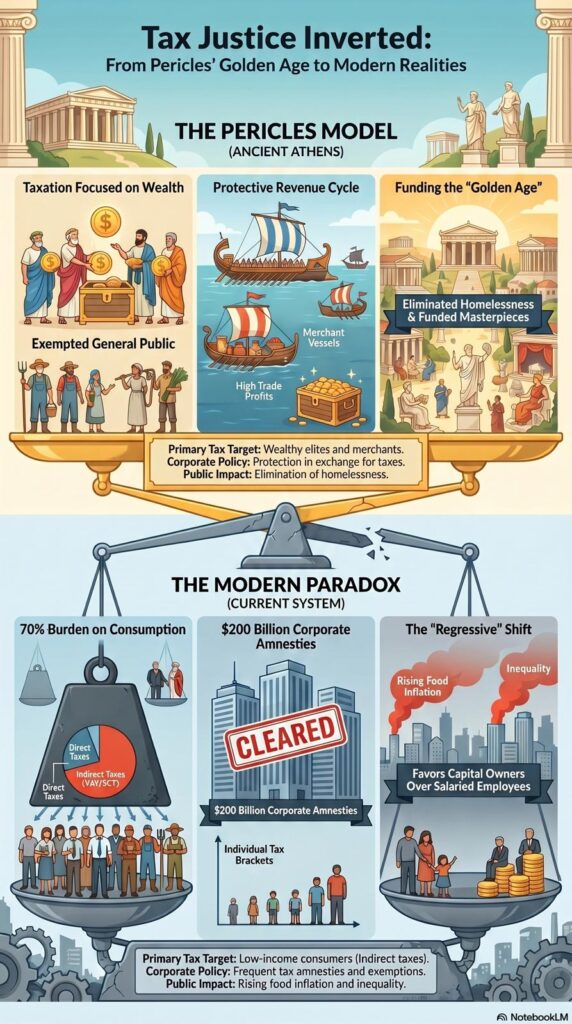
When Pericles learnt that a certain type of merchant engaged in export trade was losing vast sums of money to pirates, he assigned a portion of his powerful navy to ensure the safety of these merchants in order to put an end to this. It was necessary to convert the merchants’ income into tax revenue to be spent on the service of the Athenian people, rather than allowing it to fall into the hands of pirates. The more the merchants earned, the more tax could be collected. Now, merchant fleets set sail accompanied by warships; after travelling together until they had passed through pirate-infested waters, they would meet up again on the return journey, reaching Attica’s famous port of Piraeus without suffering any losses.
Pericles’ policies, which entirely exempted the people from taxation and focused all taxes on the wealthy, established a systemic infrastructure by concentrating taxation on specific areas. During Pericles’s reign, a range of taxes were introduced, including road tolls, land tax, port duties, import and export duties, a poll tax for free citizens and slaves, licence fees, and a progressive property tax based on wealth.
Pericles also imposed high taxes on imported food and other goods to protect local production. Families engaged in livestock farming were obliged to pay a certain fee for grazing their animals on public land. Furthermore, farmers were required to hand over half of their produce to the state. In addition to these taxes, levies were collected on salt, fishing, official documents, inheritance, and the letting and sale of property. In short, we are witnessing how this tax system, implemented by the Kingdom of Athens—which once spanned certain regions of the lands we inhabit—some 2,500 years ago, has been turned on its head in our country, particularly in recent times.
First and foremost, the tax system in Turkey is characterised by an unfair structure, as it relies heavily on indirect taxes levied on expenditure (VAT, excise duty) rather than direct taxes based on income. Approximately 70 per cent of tax revenue consists of indirect taxes, which are paid at the same rate by both the wealthiest and the poorest; naturally, this situation leads to low-income earners bearing a disproportionately higher tax burden compared to high-income earners.
The main causes and consequences of tax injustice in Turkey are listed as follows:
- Heavy Reliance on Indirect Taxes: The very high proportion of VAT and excise duty levied on consumption within total tax revenue causes the tax burden to fall disproportionately on low-income groups.
- Inequitable Tax Brackets: The rapid rise in income tax brackets for wage earners in the face of inflation means that workers are subject to higher tax rates (27 per cent, 35 per cent) at an earlier stage.
- Informal Economy: The prevalence of the informal economy hinders the expansion of the tax base and increases the tax burden on those who comply with the law.
- Capital and Wage Balance: Reducing corporation tax rates or applying exemptions without making equivalent improvements to income tax for wage earners deepens inequality and causes the tax burden to shift more heavily onto ‘salaried’ workers (wage earners).
- Tax Amnesties: Frequent tax amnesties create an injustice against taxpayers who pay their taxes regularly, whilst the size of the informal economy results in the tax burden falling solely on the shoulders of the formal sector.
Consequently, this situation points to a structure where the tax burden is not distributed fairly and negatively affects the redistribution of income. Another significant practice deepening tax injustice in Turkey is the frequent ‘tax amnesties’, amounting to billions of dollars and often making headlines. For example, Selçuk Türkoğlu, an MP for the İYİ Party in Bursa, stated in a recent announcement that over the past 18 years, the total tax debt of just five major companies, amounting to 200 billion dollars, had been written off.
Türkoğlu stated, “Tax exemptions were granted 36 times to Kolin, 30 times to Cengiz, 24 times to Makyol, 19 times to Kalyon and 19 times to Limak.” Alongside these tax exemptions, which have come to public attention due to their high amounts, it is known that ‘tax exemptions and tax amnesties’—which, whilst not publicised due to smaller individual amounts, add up to significant totals because of their sheer number—also deepen tax injustice.
Looking at the current tax situation, we first see that millions of workers pay their taxes to support Turkey’s development. Whilst working people set aside a portion of their wages each month, small businesses and families also do their bit to fund schools, infrastructure and public services; in other words, workers are striving to sustain their livelihoods and ensure their children receive a good education.
On the other hand, the wealthy and large corporations generally operate under different rules. Even when their wealth and profits have reached unprecedented levels, billionaires and giant corporations can significantly reduce the taxes they pay by taking advantage of special exemptions, alongside decades of accumulated tax evasion. In short, this system is deeply unfair. It allows those with the most resources to avoid contributing to the economy that has contributed to their success. Yet, key regulatory bodies must ensure that wealth of unknown origin and large corporations pay their fair share of taxes.
This requires the implementation of policies that prevent ultra-wealthy individuals from avoiding tax on their wealth gains; the introduction of reforms to hold large corporations accountable for the taxes they owe; the taking of steps to curb the power derived from wealth of unknown origin; and the making of investments to make life more affordable for working people.
Consequently, the tax revenues generated once justice is restored will help to re-fund essential services whilst supporting investments in healthcare, housing, childcare, the development of renewable energy, environmental protection, and other priorities that strengthen the economy.
More importantly, in Turkey—long known as an ‘agricultural nation’ but which, has transformed into an “importer of agricultural products” following the dismantling of state-supported cooperatives; rather than racing towards “world-leading food inflation”, steps must be taken to ensure a return to agricultural production capable of providing everyone with access to “adequate nutrition” – particularly for the healthy development of children – a matter that is becoming increasingly vital.
In other words, the time has long since come for the ideas, policies and advocacy activities—which, some 25 centuries ago, aimed to ensure equality and social justice through fair taxation on the wealthier sections of society and multinational corporations—
‘tax justice’—which were initiated some 25 centuries ago—it is long past time for such steps to be taken ‘fairly’ in today’s Turkey; however, it would be most accurate to say that the necessary regulations have not yet been implemented.