
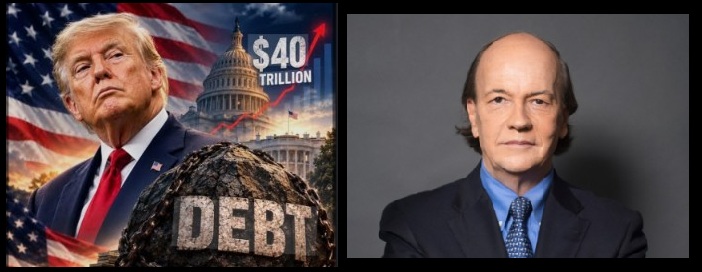
Brighton, September 7 (HNA) – US financial expert and author James Rickards has stated that the only way to reduce the US debt-to-GDP ratio – which has reached 123 per cent with a debt of 40 trillion dollars – is for Gross Domestic Product (GDP) to grow faster than debt. In an article published on the www.dailyreckoning.com website, Rickards highlighted that over the 30-year period between 1946 and 1980, this ratio fell from 119 per cent to 31 per cent, noting that
“During this period, the national debt increased significantly. However, GDP increased by more than 1,000 per cent. And that was the key. If GDP grows faster than debt, the ratio falls and America’s financial situation improves,” he wrote.
Rickards, whose books *Currency Wars*, *The New Great Depression*, *The Road to Ruin* and *Sold Out* have also been published in Turkish by Scala Publishing, drew attention to a ‘small, dirty secret’ that US Treasury Secretary Scott Bessent had failed to highlight: that inflation is not factored into the calculation of the growth rate, but it is impossible to determine how much of that GDP growth is real and how much is due to inflation. He stated that this negatively affects the dollar’s purchasing power and could erode people’s wealth and income.
The relevant section of Rickards’s article reads as follows:
“When the government calculates debt-to-GDP ratios, it uses nominal figures rather than inflation-adjusted figures. In the example above, whilst GDP grew by approximately 6.2 per cent, national debt grew by 5.0 per cent. This reduces the ratio, but does not show how much of the GDP growth is real and how much is due to inflation.
A nominal growth rate of 6.2 per cent could have been 4.2 per cent real growth plus 2.0 per cent inflation. That is a fairly healthy rate. However, it could also have been 2.2 per cent real growth plus 4.0 per cent inflation. With annual inflation of 4.0 per cent, the purchasing power of the dollar is halved in about 18 years and halved again in the following 18 years. This sort of inflation can wipe out your net worth and income if you are not prepared.
So, how much of a role does inflation play in the Bessent Plan? Minister Bessent did not say.
Investors should assume the worst-case scenario. Since the global financial crisis, the US has struggled to achieve real growth averaging above approximately 2 per cent per year. If we need nominal growth of around 6 per cent to outpace the rise in debt, and we can only achieve 2 per cent real growth per year, the difference must come from inflation. This could mean 4 per cent inflation.”
In the introduction to his article titled ‘The Dollar Is Not Dying’, Rickards notes that the financial media is rife with doomsday scenarios due to the US’s national debt, which has reached 40 trillion dollars, and that comments such as “The end of the dollar is nigh!” ‘You might assume that the dollar is already finished and that US Treasury bonds are worth nothing more than digital confetti,’ he says, adding:
“The reality is that the dollar’s position as the leading reserve currency is not under threat. Of course, foreign exchange reserves are not merely piles of cash. To a large extent, they are held in liquid financial assets, including US Treasury bonds denominated in dollars. Assets denominated in dollars will continue to dominate global reserves for decades to come.
The reason is simple. Very few government bond markets possess the size, liquidity and depth of the US Treasury market. Other major government bond markets, including those of Japan and the major European markets, do not offer the same combination of scale and liquidity. The dollar will remain king.
This does not mean that interest rates will not rise or that inflation will not increase. Both are possible. However, neither spells the end of the dollar. It simply means that the Treasury will have to pay more to borrow, and you will have to pay more at the petrol station and in the supermarket.”