
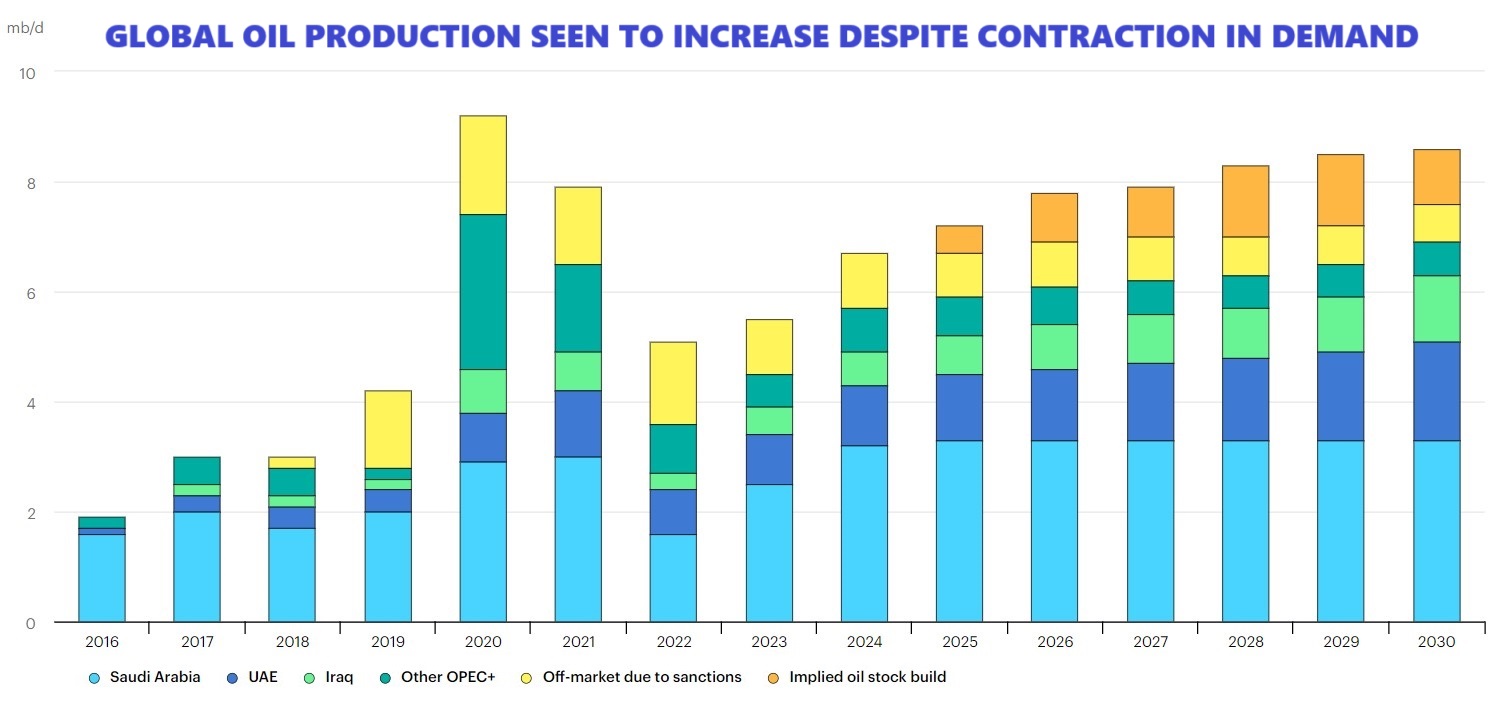
Istanbul, July 14 (HNA) – Slowing demand growth and surging supply put global oil markets on course for a major surplus this decade, according to a recent outlook report by the International Energy Agency (IEA).
Growth in the world’s demand for oil is expected to slow in the coming years as energy transitions advance. At the same time, global oil production is set to ramp up, easing market strains and pushing spare capacity towards levels unseen outside of the Covid crisis, according to the IEA’s new oil market outlook.
“As the pandemic rebound loses steam, clean energy transitions advance, and the structure of China’s economy shifts, growth in global oil demand is slowing down and set to reach its peak by 2030. This year, we expect demand to rise by around 1 million barrels per day,” said IEA Executive Director Fatih Birol. “This report’s projections, based on the latest data, show a major supply surplus emerging this decade, suggesting that oil companies may want to make sure their business strategies and plans are prepared for the changes taking place.”
Despite the slowdown in growth, global oil demand is still forecast to be 3.2 million barrels per day higher in 2030 than in 2023 unless stronger policy measures are implemented or changes in behaviour take hold. The increase is set to be driven by emerging economies in Asia – especially higher oil use for transport in India – and by greater use of jet fuel and feedstocks from the booming petrochemicals industry, notably in China. By contrast, oil demand in advanced economies is expected to continue its decades-long decline, falling from close to 46 million barrels per day in 2023 to less than 43 million barrels per day by 2030. Apart from during the pandemic, the last oil demand from advanced economies was that low was in 1991.
According to the report findings, producers outside of OPEC+ are leading the expansion of global production capacity to meet this anticipated demand, accounting for three-quarters of the expected increase to 2030. The United States alone is poised to account for 2.1 million barrels per day of non-OPEC+ gains, while Argentina, Brazil, Canada, and Guyana contribute 2.7 million barrels per day.
The report’s forecast finds that as the flow of approved projects fizzles out towards the end of this decade, capacity growth slows and stalls among the leading non-OPEC+ producers. However, if companies continue to approve additional projects already on the drawing board, a further 1.3 million barrels per day of non-OPEC+ capacity could become operational by 2030.
According to the report, global refining capacity will expand by 3.3 million barrels per day between 2023 and 2030, well below historical trends. However, this should be sufficient to meet the demand for refined oil products during this period, given a concurrent surge in the supply of non-refined fuels such as biofuels and natural gas liquids (NGLs). This raises the prospect of refinery closures towards the end of the outlook period and a slowdown in capacity growth in Asia after 2027.