
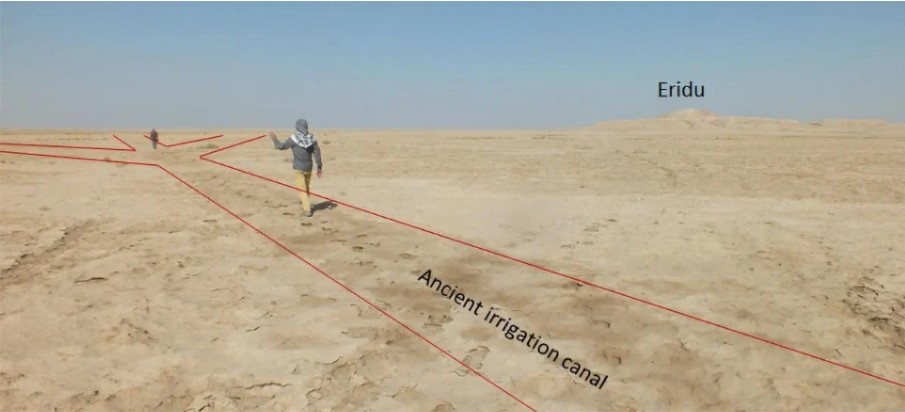
Istanbul, April 12 (HNA) – Researchers have discovered an extensive and remarkably well-preserved system of ancient irrigation canals in the Eridu region of southern Mesopotamia, offering fresh insights into early agricultural practices.
The research team, led by geoarchaeologist Jaafar Jotheri, uncovered a sophisticated water management system that dates back to before the first millennium BC, SciTechDaily reported.
The discovery provides rare insight into how ancient farmers used the Euphrates River to irrigate their fields from the sixth century through the early first millennium BC.
This significant finding deepens our understanding of early irrigation practices and underscores these early agricultural communities’ remarkable ingenuity and adaptability.
Near Basra in present-day Iraq, the Eridu region remained untouched for centuries due to a shift in the Euphrates’ course in the early first millennium BC.
This left the area dry and uninhabited, thus preserving the ancient landscape, unlike other parts of Mesopotamia where older irrigation systems were buried beneath newer canals or river sediments.
By combining geological maps, satellite imagery, drone photography, and fieldwork, researchers identified over 200 primary canals directly connected to the ancient Euphrates.
Additionally, more than 4,000 smaller branch canals were mapped, linked to over 700 farms.
This complex irrigation network reflects the advanced water management skills of ancient Mesopotamian farmers, who benefited from the natural landscape.
The high river levees allowed water to flow by gravity to surrounding fields, while breaks in the levees, known as crevasse splays, helped distribute water across the floodplain.
These techniques enabled farmers to cultivate crops on both sides of the river, although the northern side was more heavily farmed.
The study also highlights how the irrigation system evolved over centuries.
The canals required significant labour and expertise to maintain, suggesting that different network parts were likely used at various times.
Further research aims to date each canal to understand changes in farming practices over time better.
Comparing the canal designs with descriptions from ancient cuneiform texts could provide even more insight into agricultural management in Mesopotamia.
Reference: “Identifying the preserved network of irrigation canals in the Eridu region, southern Mesopotamia” by Jaafar Jotheri, Mohammed Rokan, Ali Al-Ghanim, Louise Rayne, Michelle de Gruchy and Raheem Alabdan, 18 February 2025, Antiquity.
The project was funded by the British Institute for the Study of Iraq in London and is a collaboration between Durham, the University of Al-Qadisiyah in Iraq and Newcastle University, UK.