
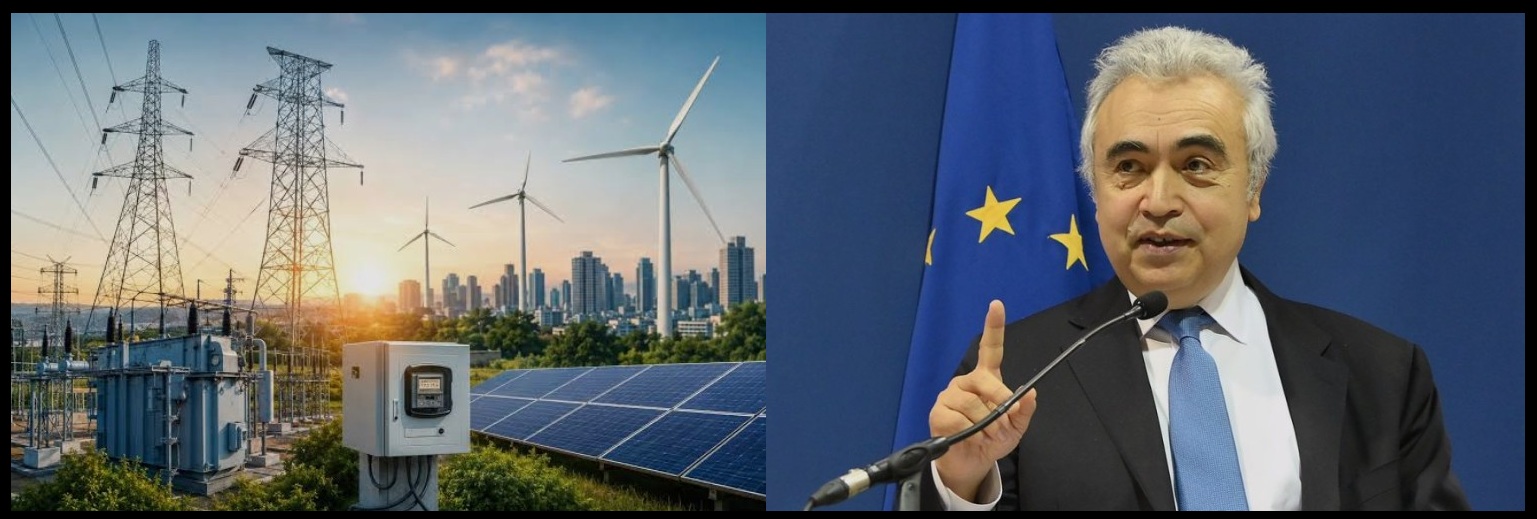
Istanbul, August 19 (HNA) – According to data from the International Energy Agency (IEA), the energy sector, entering the ‘Age of Electricity’ and supported by rising investment in energy infrastructure, has become the ‘driving force behind employment growth’.
IEA executive director Fatih Birol said, “Global energy demand continued to increase in 2025 against a complex economic and geopolitical backdrop, with one trend unmistakeable: the expanding electrification of economies, which shows us that the world has entered the ‘age of electricity.’ Electricity consumption is growing much faster than overall energy demand — and one energy source is growing much faster than any other.”
According to the report, which is based on the IEA’s Employment Surveys, in 2024, employment in the global energy sector rose by 2.2 per cent compared with the previous year, driven by energy infrastructure investment; this increase was almost double the 1.3 per cent rise seen across the wider economy. Consequently, the energy sector has created an average of over 1 million jobs annually since 2019:
The IEA report states: “This represents an increase compared to the period between 2015 and 2019, when the sector created an average of 300,000 jobs per year. Consequently, electricity is playing an increasingly central role in energy expenditure and employment. According to the data, between 2015 and 2024, investment in electricity generation rose by 70 per cent, whilst employment in the sector increased by 27 per cent, driven by growth in solar photovoltaic (PV) and wind energy,” it was stated, and further explained:
“This shift reflects the energy sector’s entry into the ‘Age of Electricity’; in this era, electricity is assuming an increasingly central role in modern economies due to rising consumption driven by factors such as industry, electric vehicles, air-conditioning systems and data centres. As electricity systems continue to expand, grid systems must develop in parallel. Annual investment in electricity grids increased by 30 per cent between 2013 and 2024. This growth has also highlighted the need for a skilled workforce and emphasised the important link between energy policy and workforce planning.”
Conversely, the report emphasises that the electricity grid sector faces not only a shortage of skilled labour but also an ageing workforce, stating: “This situation leads to a need for additional skilled workers to replace those approaching retirement and increases the need to attract and train more workers for the sector. Energy efficiency measures can curb the rise in energy consumption by reducing the amount of energy required to sustain and grow economies. Energy efficiency interventions offer numerous benefits, such as enhancing energy security, lowering energy bills and reducing the environmental impact of energy use,” it was stated.
In particular, the IEA report emphasised that energy demand has risen significantly over the past decade, accompanied by strong growth in investment in renewable energy and energy efficiency. It noted: “Whilst the expansion of renewable energy production and energy efficiency is supported by investment and the widespread adoption of technology, it requires a workforce with the appropriate skills in these areas. In this context, the availability of a skilled workforce emerges as a critical factor in ensuring safe, affordable and sustainable energy systems,” the report stated.
The report underlined that this situation requires workers in many regions where the energy sector is developing rapidly to acquire new skills, creating increasing pressure on education and training systems to keep pace with this change,
“To help policymakers, industry representatives, educators and workers’ representatives meet these changing labour force needs, there is a need for further information on the latest trends in labour shortages and skills gaps, as well as on policies that will help education and training systems adapt to changing conditions,” the report noted, continuing as follows:
“This report combines the IEA’s new analysis of online job advertisements with IEA employment modelling and data obtained from relevant stakeholders. The report examines how labour force needs and skill requirements have changed in key energy sub-sectors, including solar PV, wind and energy efficiency. The report’s key findings are as follows:
- Demand for occupations, qualifications and skills is changing. Drawing on new analyses of online job advertisements, the IEA Employment Surveys and other data sources, the report provides insights into the characteristics of labour demand. The analysis highlights how skills requirements are changing by examining the balance between transferable and sector-specific competencies and identifying emerging skills across sub-sectors. It also identifies the most in-demand occupations and examines how these trends vary across sub-sectors and regions.
- Addressing labour shortages and skills gaps is, by its very nature, a multi-stakeholder issue. Drawing on insights from two workshops jointly organised by the IEA and the European Commission, the report presents numerous examples of good practice demonstrating how multi-stakeholder approaches can effectively address these complex and emerging policy needs.
- Finally, the report emphasises that the low attractiveness of careers in the energy sector, limited educational opportunities and accessibility, and the mismatch between energy policy and labour force planning constitute the key barriers to developing a sufficiently large and skilled workforce. The report assesses policy approaches aimed at removing these barriers to ensure that workforce development keeps pace with the changing needs of the clean energy transition.”