Can Baydarol
Next week, Ankara will be hosting the heads of state of NATO countries. As I’ve been observing the comings and goings of daily life in Ankara over the past few weeks, I’ve realised once again just how right I was to decide not to live in the capital. I wish all my friends living in Ankara and all the people of Ankara every patience.
We have already noted how daily life has turned into an open-air prison; the arrests carried out out of fear that ‘God forbid, they might stage a protest and make us look a disgrace!’; the houses that have been painted over or had curtains drawn across them so that ‘our poverty isn’t on display!’; and the fact that, presumably on the grounds that ‘one cannot skimp on prestige’, for the time being only the runway at the airport where the NATO leaders will land is being renovated (Etimesgut), and “opposition journalists denied accreditation for fear they might ask absurd questions and cause a scandal”—we have already taken note of all this. Let’s see what else we’ll witness on 7–8 July.
As for the suspicions…
It first emerged like a tabloid story. US President Trump said of Italian Prime Minister Meloni, “She begged to have her photo taken with me!” Meloni then gave Trump the response he deserved with remarks to the effect of, “An Italian prime minister would never beg!”, thereby boosting her popularity in domestic politics.
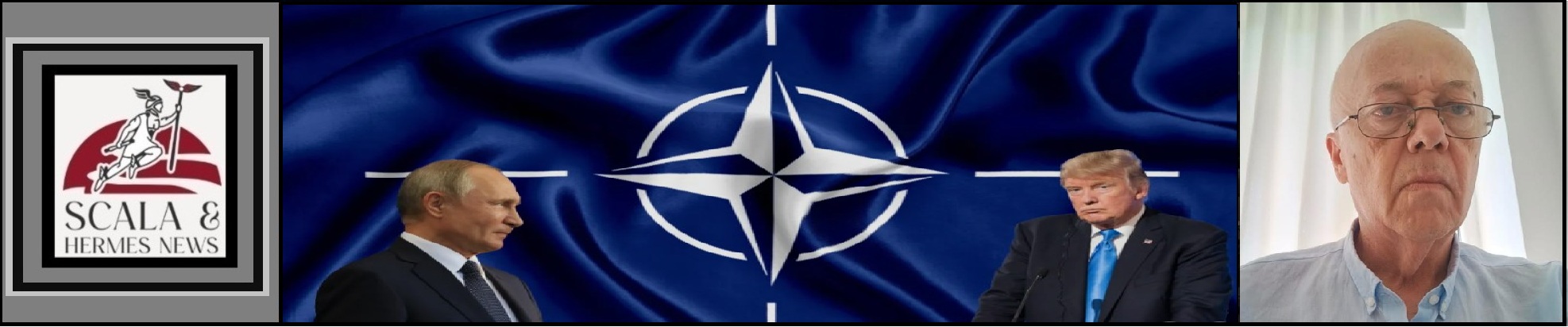
Building on this, you might ask, “So what? The love between the two has gradually turned to hatred – what’s it to us?” However, when the Trump–Meloni relationship is extrapolated to European NATO countries as a whole, it is possible to see traces of the same hatred in all bilateral relations. Are there no exceptions? We can mention two exceptions. Although he gets very angry from time to time, we know that Trump’s relationship with Netanyahu is not particularly strained. We’ve been hearing more frequently in recent days about his affection for our President Erdoğan, and he never fails to renew his warm regards on every occasion. So much so that, whilst it was said Trump might not visit Ankara due to his anger towards European NATO countries, it appears he has changed his mind because of his affection for Erdoğan and will be gracing the skies over Ankara in his new aeroplane—the ultimate example of nouveau riche ostentation.
Naturally, Trump has already indicated that he will be bringing good news for Erdoğan. In all likelihood, his plane is ready, and engines are on their way for our fighter jets that lack them. As for CAATSA sanctions and the F-34s—or even the F-16s—there seems to be no hope for the time being. As we mentioned in a previous article, will there be a SWAP? I have my doubts on that point too. According to experts, the US economy is in a tight spot regarding this deal. Given that the dominant election signals have not materialised to the extent seen in the recent six-month interest rate renewals, the possibility of a SWAP appears to have been shelved for the time being.
So, what is the main point of our scepticism? If Trump has become so affable and generous, what will he ask of us? We do not know…
Let’s turn to the preliminary assessments regarding the Summit. According to some NATO experts I trust implicitly, it would be wrong to refer to this summit merely as a NATO Summit. It should, in fact, be viewed as NATO ME (NATO Middle East) or NATO 3.0. In other words, NATO is set to expand into the Middle East and make its third major strategic shift. Whilst NATO 1.0 was a defence organisation against the Soviets during the Cold War, 2.0 transformed into an organisation primarily aimed at countering Russia following the fall of the Berlin Wall. To understand the new position it is set to adopt today, let us first examine the messages coming from the US ahead of the Summit:
- The US no longer wishes to contribute more to NATO’s defence budget;
- During the Iran conflict, the US did not receive sufficient support from its allies; the Strait of Hormuz crisis was more of a crisis for EU countries than for the US;
- On the front against Iran, the security of Israel and energy routes now falls more under the responsibility of the EU and regional countries; in this context, the Abraham Accords should apply to everyone.
- A united front against China must be decisive for the region’s security.
Whilst the US is listing the demands we can compile within this framework, the EU’s primary concern relates to the growing Russian threat. The creation of a military force—both in terms of armaments and troop strength—to compensate for the US’s reduced presence in NATO’s European wing is the number one issue for EU countries, particularly Germany. In this context, the support for Ukraine – particularly its recent drone attacks deep into Moscow, specifically targeting oil refineries – and the fact that Russia may be facing oil restrictions for the first time in history, are by no means a coincidence.
So what impact will all this have on us? Should we fear a potential reorientation of NATO’s identity? Or, given that we will be at the centre of all these changes, should we be delighted at our growing strategic importance? Is the mere fact that the Summit is being held in Ankara not an indication of just how important we have become?
Whilst we shall assess the pros and cons of what is to come after the Summit, let us emphasise that we harbour various reservations about the process. You see, human nature is such that we tend to turn a deaf ear to bad news and wish to interpret everything in a positive light – but still, one can’t help thinking, ‘If only it weren’t for that Barrack!’