
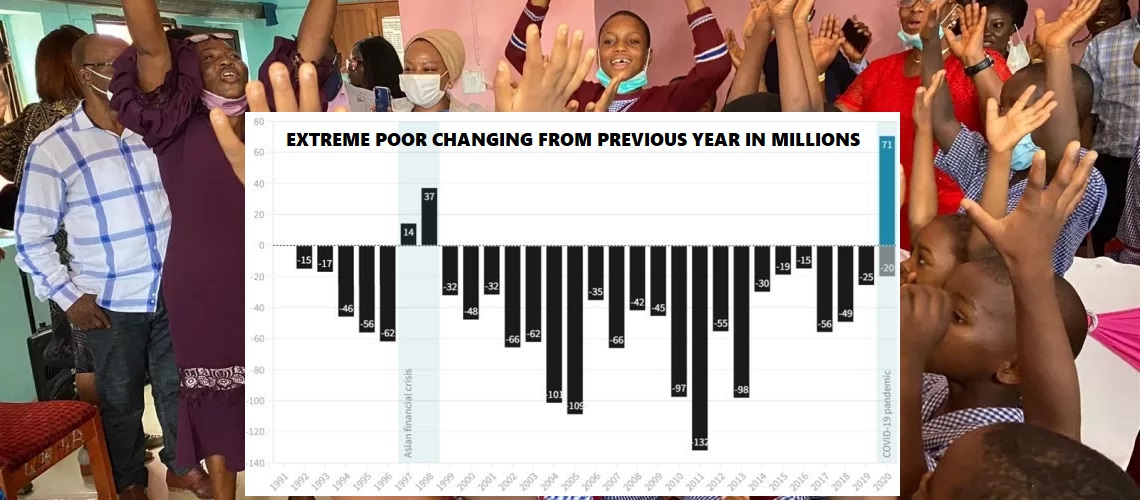
Deniz Kılınç / Istanbul, October 23 (HNA) – The COVID-19 pandemic triggered a historic setback, pushing 70 million people into extreme poverty in 2020 – the largest one-year increase in three decades, stated Mari Pangestu, the World Bank Managing Director of Development Policy and Partnerships, in her blog on End Poverty Day.
The war in Ukraine deepened the global economic slowdown, which is now in its steepest decline following a post-recession recovery since 1970, she said, adding that, “At this rate, nearly 7.0 percent of the world’s population – almost 600 million people – will still be struggling in extreme poverty in 2030.”
“Whilst the picture is sobering, it is a wake-up call for us to think and act to correct course” she said, underlining the “importance” of remembering many of the development challenges we face today, which did not start with the pandemic.
Riding on the momentum to build back better, it was a good time to review deficiencies of past policies and underinvestment, she said adding that, we must correct course now across a comprehensive range of policies and step-up global cooperation for a lasting recovery to move towards green, resilient, and inclusive development.
“In any crisis, it is the poor that are hit hardest” she stated, adding that, the poorest people bore the steepest costs of the COVID-19 pandemic: income losses averaged 4.0 percent for the poorest 40 percent, double the losses of the wealthiest 20 percent of the income distribution, according to the latest World Bank analysis.
It is the poor who do not have the resources to cope. During the pandemic, strong fiscal policy measures did help to protect poor and vulnerable people, but poor countries were less successful than rich countries. With less to spend, low- and lower-middle-income economies offset barely a quarter of the impact on poverty.
“What may be even more worrying are the long-term consequences of multiple overlapping crises, which could worsen poverty in the near future if we do not accelerate action. Losses in learning and human capital, as well as climate change, are among the most critical” she underlined and added:
“Losses in Learning and human capital: As a result of prolonged school closures and shocks to household incomes during the pandemic, learning poverty has increased by a third in low- and middle-income countries. This means that an estimated 70% of 10-year-olds are unable to understand a simple written text.
“Today’s students could lose 10 percent of their future average annual earnings as a result. Youth have also suffered a loss in human capital, in terms of both skills and jobs. Short-term declines in youth employment can lead to more frequent unemployment spells, lower future wages, and increased social unrest. Beyond reducing incomes, the decline in human capital will lead to lower productivity and less inclusion for decades to come, hindering growth, and increasing poverty and inequality.
“These trends can be reversed if countries act quickly and decisively, guided by evidence on what works. We must keep schools open, assess students and match instruction to their levels, streamline the curriculum and focus on foundations – especially literacy, numeracy, and core socioemotional skills. And we need to create a national political commitment to learning recovery, guided by credible measurement of learning. We must not forget to invest in girls’ education – which may well be the highest-return investment available in the developing world.”
Touching on climate change, she said, the climate crisis was already “here” and it could push an additional 132 million people into poverty by 2030. The adverse consequences of climate change—water scarcity, crop failure, food insecurity, economic shocks, migration, and displacement— can multiply threats by exacerbating conflict, reducing economic opportunities and social cohesion, as well as straining public institutions.
“We need to make sure that climate is integrated into development and ensure a well-managed ‘just’ transition towards clean energy sources in a way that protects people, communities, and the environment. Developing countries face a triple penalty – they pay more to provide electricity services; they are locked out of economical clean energy projects, and they are locked into fossil fuel projects with high and volatile variable costs. We will need impactful programs and projects, adequate public policies, and significantly increased funding from multiple sources. Countries need to also invest in adaptation and resilience.
A resilient recovery will depend on a wide range of policies, including fiscal reforms that reorient spending away from subsidies toward support targeted to poor and vulnerable groups, and improvements in efficiency and efficacy” she said and went on as follows:
“Prioritizing long-term growth requires appropriate investments in crisis readiness, too. COVID-19 showed us how progress achieved over decades can vanish overnight when such readiness is lacking. Public investments that support long-run development, such as investments in the human capital of young people or investments in infrastructure as well as research and development can have a positive impact on growth, inequality and poverty decades later.
“We must respond to current challenges in ways that do not further impoverish the poor today and focus on creating opportunities that they can enjoy tomorrow.”