
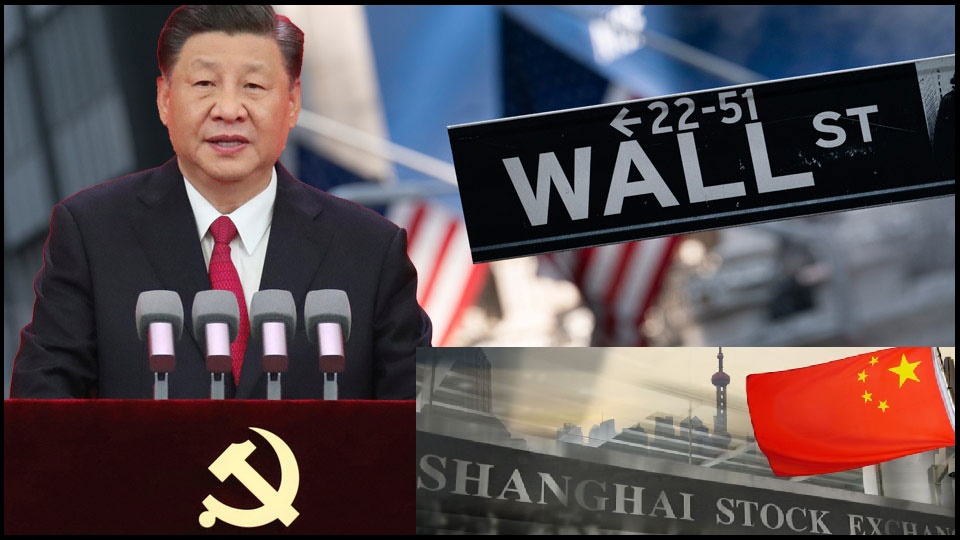
London, August 26 (HNA) – The stock market analysts and financial advisors warned the investors who parked their money in Chinese tech stocks, with saying “Shareholders beware, socialism is back,” according to People’s World (PW).
Behind the investor, panic is a stepped-up regulatory campaign by the Communist Party of China (CPC) that aims to combat inequality, lower living costs for working families, impose order on often chaotic markets, and prevent monopoly control over key sectors of China’s economy, PW reported.
President Xi Jinping told the world in July that China’s leaders were determined to “safeguard social fairness and justice and resolve the imbalances and inadequacies in development” to solve what he called “the most pressing difficulties and problems that are of great concern to the people.
Xi was speaking to a local crowd at the CPC’s centenary celebration in Beijing; most Western media treated his remarks as just another propaganda speech: heavy on socialistic verbiage but nothing to be all that concerned about.
But many may now be rereading his words for clues as to what might be coming next. That’s because, over the last several months, Chinese authorities have embarked on what many in the international investor class see as a full-fledged assault on their wealth—a class struggle salvo aimed directly at them.
Waves of new regulations issued by the State Council have targeted various sub-segments of China’s $4-trillion tech economy lately: education, insurance, gaming, e-commerce, fintech, and others. Fresh controls to contain rising costs and bend industries to better serve the public interest are emerging on an almost weekly basis.
No less than 50 different regulatory actions have been executed against dozens of different firms for a range of offences and lapses—price gouging, false advertising, monopolistic exploitation, failure to protect users’ data privacy, and more. Calculations made by The Economist magazine estimate that government enforcements have chopped at least $1 trillion from the share prices of the various companies involved, exacting a big hit on investors’ portfolios.
Given the dizzying pace of legislation, some in the Western business press have resorted to old-school anti-communist rhetoric to criticize the government. The right-wing journal National Interest claims “Xi Jinping’s personal dictatorship” is destroying all of China’s capitalists and decimating the wealth of many outside the country.
Other outlets have been slightly less hysterical, preferring a more sophisticated style to deliver a similar message. The Wall Street Journal, the flagship paper of the U.S. financial establishment, warned in a July 27 editorial that Xi is on a mission “to bring ever greater swathes of China’s private economy under the state’s control.”
Alan Song, founder of private equity firm Harvest Capital, speaking to Reuters, lamented last month that “a new era that prioritizes fairness over efficiency” has unfortunately begun in China. “Chinese entrepreneurs and investors,” Song said, “must understand that the age of reckless capital expansion is over.”
Lately, the prime exhibit for the China-is-destroying-capitalism accusation is the set of regulations targeting private after-school tutoring firms, which were forbidden last month from seeking foreign capital, forced to cut their operating hours, and obligated to make big chunks of their business into non-profit organizations.
The restrictions, the government says, will save families money and rescue children—who often spend just as much time at tutoring sessions as they do in school—from classroom burnout. Tutoring is a 120 billion dollars industry, and the Ministry of Education plans to beef up public schools to take its place for K through 9 students while also reducing the burden of homework weighing down kids in China. (And also, the government hopes, reduce the costs of child-rearing and help reverse declining birth rates.)
In the wake of the changes, some of the top Chinese tutoring companies listed on the U.S. stock market—names like TAL Education, New Oriental, and Gaotu Techedu—saw their share prices plunge up to 90 percent almost overnight. Billions were wiped out, leaving a lot of investors shocked and angry.
In another example, online insurance sellers have been ordered to halt illegal marketing and pricing practices that bilked workers out of their hard-earned yuan. According to the Shanghai Securities News, the state wants to “purify the market environment” and “protect the legal interests of consumers.”
As of last year, some 146 insurance companies had entered the so-called “insurtech” sector in China, hawking health insurance, life insurance, property insurance, and all manners of coverage online. Many unlicensed companies also rushed to make fast cash in the sector, which saw high double-digit expansion. Banking regulators have given companies until the end of October to clean up their act, or else.
And when it comes to online shopping and social media, the National People’s Congress just passed a new Personal Information Protection Law that will force companies like e-commerce giant Alibaba, tech conglomerate Tencent, Tik Tok owner ByteDance, and others to obtain consent before collecting people’s data and follow strict new requirements to keep it safe.