ChatIn, Celaleddin and Dimrit

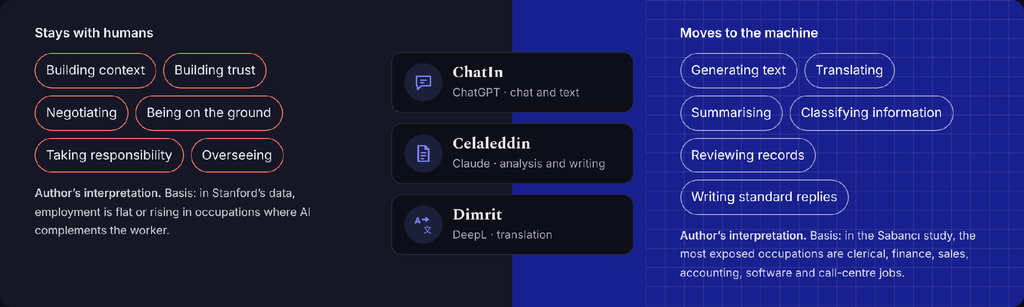
Figure 01 – Stays with humans, moves to the machine
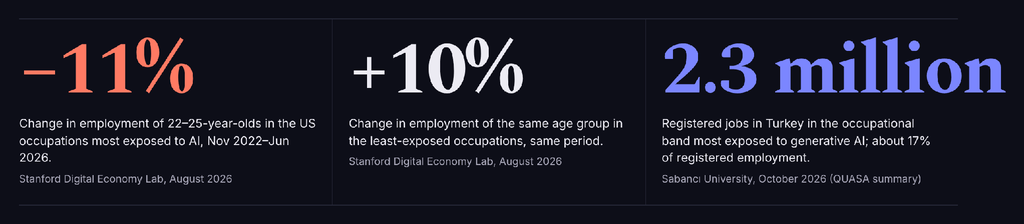
Figure 02 – Figures – −11%, +10%, 2.3 million
I have given human names to the three AI tools I now lean on most heavily at work: ChatGPT is ChatIn, Claude is Celaleddin, DeepL is Dimrit. An HR consultant would no doubt applaud the team spirit. All three are part of my job — or rather, my jobs. But that team spirit has come at a price. That same technology had a hand in the loss of my main source of income — content-heavy corporate communications. In translation business, which I have long done on the side, it has made my working life markedly easier. So I now have super intelligent colleagues who pick my pocket with one hand and shave hours off my day with the other. Three of them, no less.
What really takes my breath away is the sheer speed of it all. When ChatGPT launched in November 2022, it was a novelty; in under four years it has become the protagonist of every labour-market report. The most important academic study behind this piece — Stanford’s “canaries” paper, which tracks the occupations most at risk — has been revised three times in fifteen months. The literature ships a new edition before I can finish an article. What follows tests the bigger picture behind my own double-edged experience against the latest evidence from the international press and academic research. The question is a simple one: whose job is AI taking right now?
The canaries: the casualties are the people never hired
The key to understanding AI’s impact on white-collar work is to look not at who is being let go, but at who is never being hired. Erik Brynjolfsson, Bharat Chandar and Ruyu Chen of the Stanford Digital Economy Lab combed through records covering millions of workers at ADP, America’s largest payroll provider. The paper’s title nods to the birds miners once carried underground as an early warning of toxic gas: “Canaries in the Coal Mine?”
The headline finding is stark. Between November 2022 and June 2026, employment among 22- to 25-year-olds in the two occupational quintiles most exposed to AI fell by roughly 11 per cent. Among their peers in the three least-exposed quintiles, it rose by roughly 10 per cent (Stanford Digital Economy Lab, 12 August 2026). Same age, same economy, very different fortunes.
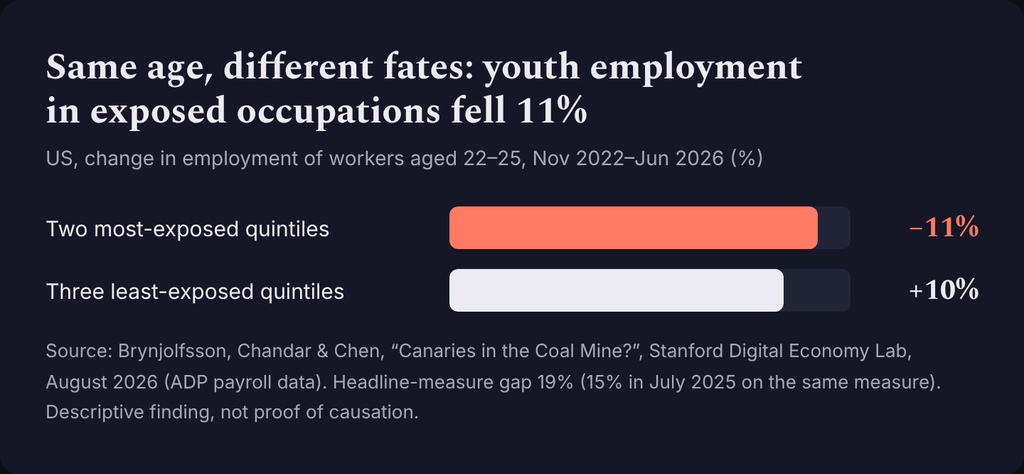
Figure 03 – Same age, different fates- youth employment in exposed occupations fell 11%
By June 2026, employment among 22- to 25-year-olds in the more AI-exposed occupations was running about 19 per cent below where it would have been had it tracked that of their peers in less-exposed jobs. On the same measure, the gap stood at 15 per cent in July 2025. Earlier versions of the study, published in August and November 2025, used a different method — one that controls for firm-specific shocks — and found relative declines of 13 and 16 per cent respectively. Both approaches show young workers’ fortunes diverging in the same direction.
Most of that gap reflects companies hiring fewer young people. The decline is concentrated in occupations where AI takes over some of the work. Where AI instead helps people do their jobs, employment is holding steady or growing. More experienced workers in the same exposed occupations show no comparable shortfall. For now, the shift is showing up in hiring rather than in pay.
The Stanford team is admirably frank about the limits of its own work. Its very first finding is that there are no widespread layoffs across the economy. The gap narrows once education is taken into account, and some of the divergence predates the spread of generative AI. The gaps in the ADP sample are also larger than those in national surveys. In a February 2026 note, the authors add that under the most stringent controls the decline becomes statistically significant only in 2024. The findings are an early warning, not proof of cause and effect.
Data from the Federal Reserve Bank of New York point the same way — with a caveat. Unemployment among recent college graduates aged 22 to 27 climbed from 3.6 per cent in March 2019 to 5.6 per cent in March 2026 (New York Fed, 28 May 2026). Having run below the overall jobless rate since 1990, it has sat above it since 2021 (IBISWorld, citing New York Fed data). In the third quarter of 2026, recent-graduate unemployment eased to 5.2 per cent. Over the same period, the share of graduates in jobs that do not require a degree — underemployment, in other words — rose to 42.5 per cent (New York Fed, November 2026). That is not a record: it was at the same level at the end of 2025, and the pandemic peak was 43.4 per cent. But it is the highest plateau since 2020.

Figure 04 – Recent-graduate unemployment has risen since 2019
Here is the caveat. According to New York Fed researchers, 64 per cent of the rise in young-graduate unemployment since the pandemic can be explained by remote work — and the increase began before AI went mainstream (CBS News, 2026). The two findings do not contradict each other, but each puts limits on the other. AI is not the prime suspect behind youth unemployment as a whole. What Stanford has captured is narrower and sharper: a split among people of the same age, between those in at-risk occupations and those outside them. Because remote work has hit office jobs harder, it may account for part of that split as well — something Stanford’s method cannot fully rule out.
Is the knowledge worker toast?
The classic automation story unfolds on the assembly line: a robotic arm takes the worker’s place. Generative AI has turned that story on its head. Language models have learned to stand in not for muscle, but for writing, summarising, classifying and translating — the very tasks at the heart of white-collar work. How is a knowledge worker supposed to compete with a language model that fits every pocket, with subscriptions in Turkey costing between 250 and 1,000 lira a month (Chip, October 2026; Teknoblog)? Even as I type that question, I can’t decide whether to laugh or cry.
A Microsoft Research study published in July 2025 mapped 200,000 anonymised conversations with Copilot users onto occupations. AI proved most applicable to jobs built on providing and communicating information, with translators, historians and writers at the top of the list. News analysts, reporters and journalists, and radio announcers made the list too. I appear on it twice; I couldn’t work out which entry to mourn first. The least affected were jobs involving physical equipment — dredge operators, bridge and lock tenders, water-treatment plant operators. The researchers also found that occupations requiring a bachelor’s degree were more exposed than those requiring less schooling (Microsoft Research; Fortune, 31 July 2025).
According to the global index updated by the International Labour Organization (ILO) in 2025, one in four jobs worldwide is exposed to generative AI to some degree, with the highest risk in clerical and secretarial work. The “highest risk / most exposed to AI” category, however, accounts for just 3.3 per cent of global employment for now (ILO Working Paper 140, 2025). An ILO research note from March 2026 found that female-dominated occupations are almost twice as likely to be exposed as male-dominated ones.
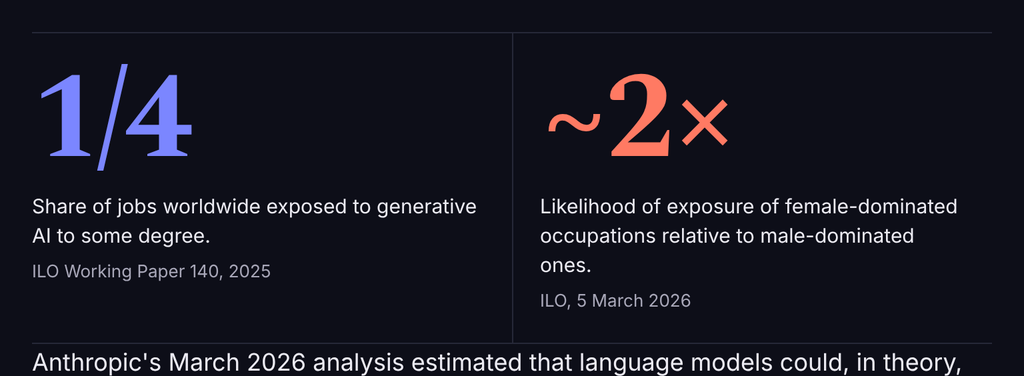
Figure 05 – Figures – 1-4, ~2×
Anthropic’s March 2026 analysis estimated that language models could, in theory, perform 94 per cent of tasks in computer and mathematical occupations and 90 per cent in office and administrative ones (Anthropic, “Labor market impacts of AI”, 5 March 2026). But what is theoretically possible is not the same as actual use, let alone job losses: in a US survey cited by Goldman Sachs in August 2025, only 9.3 per cent of companies said they had used generative AI in production over the previous fortnight.
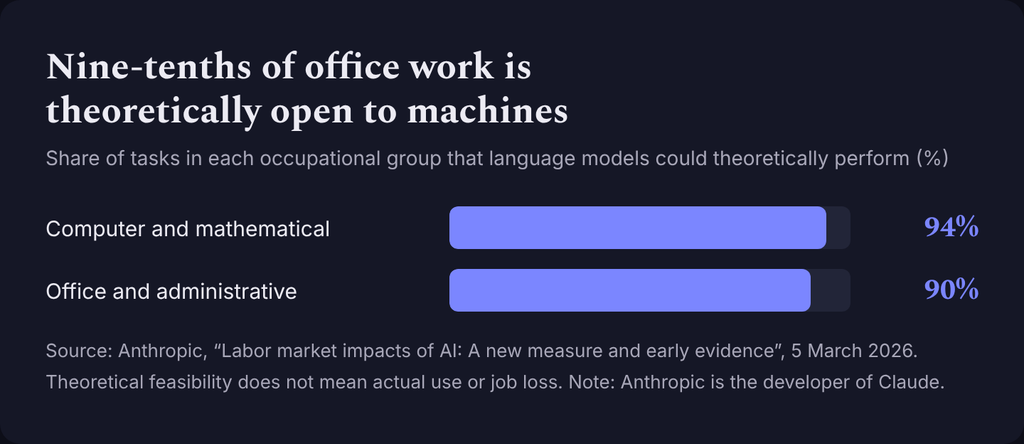
Figure 06 – Nine-tenths of office work is theoretically open to machines

Figure 07 – In theory it can do the whole job; in practice it is not there yet
In the World Economic Forum’s Future of Jobs Report 2025, employers name cashiers, administrative assistants, executive secretaries, accountants and auditors among the roles they expect to shrink fastest. The jobs expected to grow most in absolute terms by 2030 are farmworkers, delivery drivers and construction workers (WEF, January 2025). A March 2026 Fortune report, drawing on Randstad data, found that America’s data-centre building boom is driving electricians’ and technicians’ pay to record highs. AI is downsizing the office while building out its own construction site.
2026: AI-attributed layoffs had overtaken all of 2025 by May
Challenger, Gray & Christmas, which has logged US job cuts by stated reason since 2023, recorded 54,836 cuts attributed to AI over the whole of 2025. In 2026, that total was surpassed by May. The 38,579 AI-attributed cuts announced that month were the highest monthly tally since Challenger began tracking the category; roughly 40 per cent of all job cuts announced in May cited AI (CFO Dive, June 2026).
Then the curve turned. AI’s share of monthly cuts, which had hovered between 25 and 40 per cent from March to July, dropped below 10 per cent in August and September (TheStreet, October 2026). In October, AI accounted for a mere 1,265 job cuts — the lowest month of the year. AI-attributed cuts for the year to date reached 121,401, more than double the 2025 figure (HCAMag, November 2026). But “market and economic conditions” lay behind 130,531 cuts, overtaking AI as the most frequently cited reason of 2026 (TheStreet; CPA Practice Advisor, November 2026). Total job cuts for the year stood at 617,189, down 44 per cent on the year before (Trading Economics, November 2026).
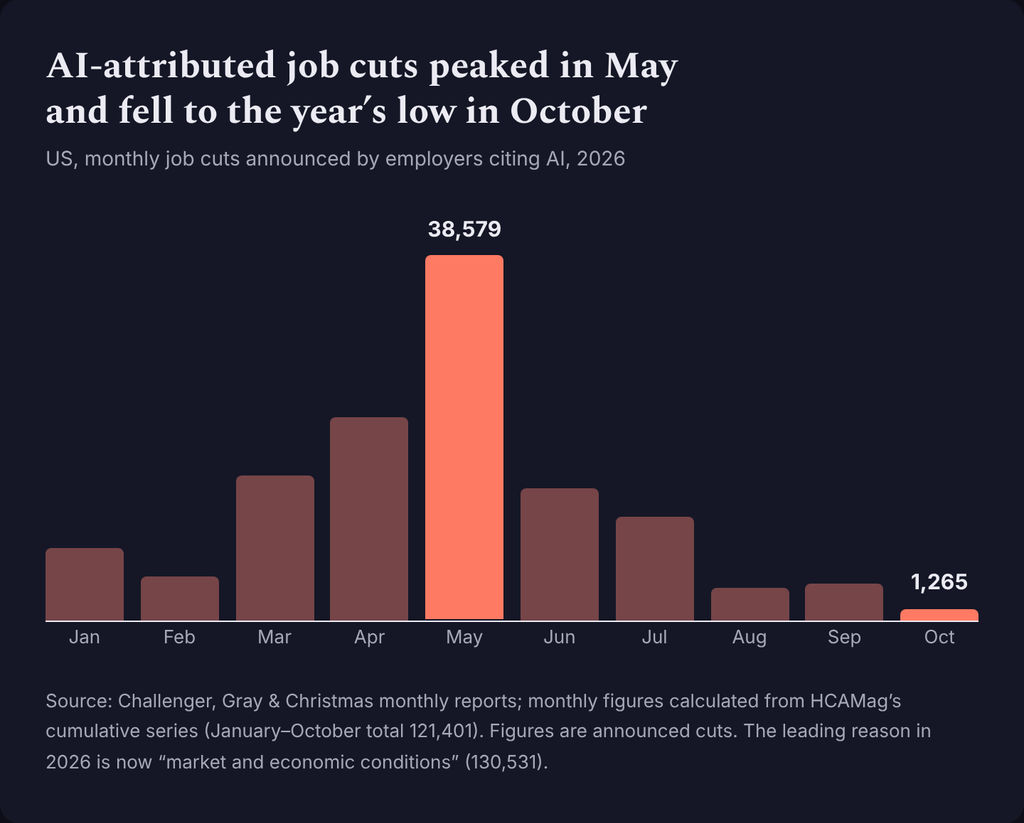
Figure 08 – AI-attributed job cuts peaked in May and fell to the year’s low in October
There are two ways to read this decline. The first: AI was a fashionable excuse. Andy Challenger concedes that the market rewarded companies that talked up AI. The second: companies front-loaded their restructuring early in the year, then stopped. The data available cannot tell the two apart. But one thing holds either way. In Andy Challenger’s words, even when the job itself doesn’t go to AI, the money for that job does (CBS News, May 2026).
Amazon is a case in point. Between October 2025 and January 2026, the company cut around 30,000 corporate roles. That is a sliver of its 1.58 million-strong workforce, most of whom work in warehouses and fulfilment centres — but it amounts to roughly 10 per cent of its corporate staff (Reuters, 28 January 2026). Chief executive Andy Jassy had said in 2025 that generative AI would shrink the corporate workforce over time (Fortune, 28 October 2025); once the layoffs began, he insisted the reason was bureaucracy, not AI (Reuters). The Amazon case is therefore a symptom rather than proof: the company itself cannot settle on a rationale. The only thing that is clear is that the axe fell at head office, not in the warehouse.
Dimrit and the translators
Translation became generative AI’s first laboratory in the labour market. According to the American Translators Association, translators have been weaving AI into their workflows ever since neural machine translation took off around 2016 (NPR Planet Money, June 2024). Neural tools such as DeepL, followed by large language models, turned that integration from a productivity boost into downward pressure on rates.
In January 2024, 787 members across all professional groups responded to a survey by the Society of Authors, the UK’s largest union for writers and translators. Among the translators who responded, 36 per cent said they had lost work to generative AI and 43 per cent said their income had fallen; 77 per cent believe generative AI will eat into their future earnings (The Next Web; The Guardian, April 2024).
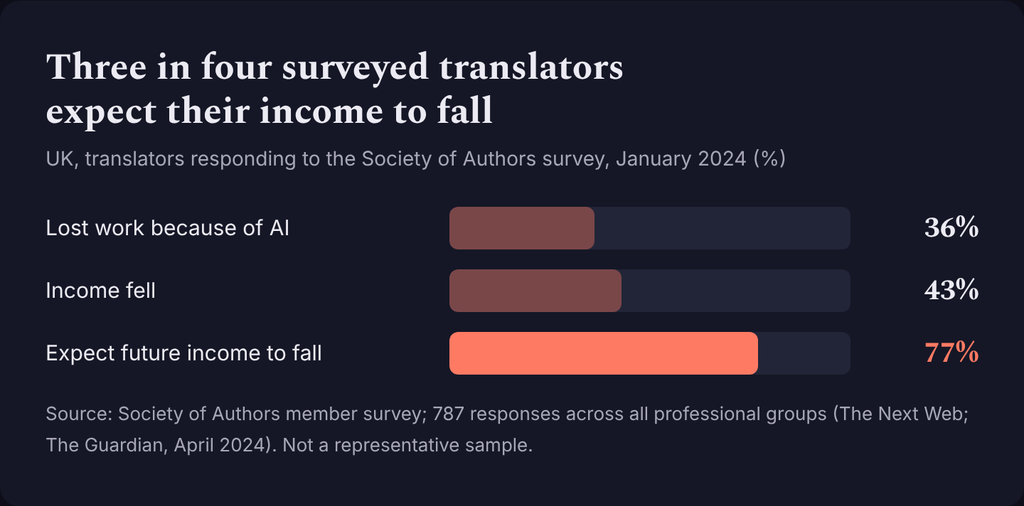
Figure 09 – Three in four surveyed translators expect their income to fall
Carl Benedikt Frey and Pedro Llanos-Paredes of the Oxford Martin School measured the impact of an older technology: Google Translate. Comparing 695 local labour markets in the US after 2010, they found that translator employment grew more slowly wherever machine translation spread faster. By the authors’ reckoning, that means some 28,000 translator jobs that would have been created between 2010 and 2023 never materialised. The study also predicts that demand for foreign-language skills will keep falling (VoxEU/CEPR, March 2025).
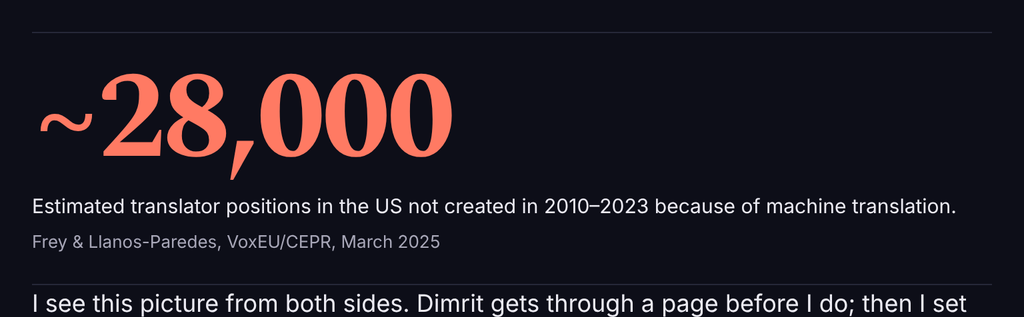
Figure 10 – Figures – ~28,000
I see this picture from both sides. Dimrit gets through a page before I do; then I set about fixing its draft. The industry calls this “post-editing”; I call it “tidying up after it”. Translating from scratch is steadily giving way to this kind of work, and this kind of work is paid less. The winner from the productivity gain is the employer, not the translator.
The Washington Post: nearly half the newsroom gone
In journalism the picture is bleaker — and messier. On 4 February 2026, the Washington Post announced it was laying off about a third of its staff (NBC News; Al Jazeera). According to the Columbia Journalism Review, the newsroom lost even more — close to half its people. Union representatives put the newsroom loss at between 44 and 47.5 per cent (Washingtonian, February 2026). CJR also reports that the Post’s organic search traffic fell by half over three years, and AI summaries that intercept readers before they ever reach the story are part of that slide. But they are not the whole story: the Post’s loss of subscribers and shifts in its owner’s editorial line have also fed the crisis (Washington Times, February 2026).
McClatchy, which owns thirty newspapers, turned to AI-assisted content even as it cut at least 90 unionised staff (Tech Policy Press, October 2026). The Associated Press offered voluntary buyouts to more than 120 employees (Fortune, April 2026). The ProPublica union won strike authorisation, in part over AI protections — a first for a major US newsroom (Nieman Lab, March 2026). Yet in Challenger’s figures, news-industry job cuts through July stood at 1,311, slightly below the year before (Challenger, Gray & Christmas, August 2026). In other words, the damage to journalism is spreading less through waves of mass layoffs than through the collapse of big institutions and jobs that are never advertised. A familiar pattern…
Turkey: 17% of jobs at risk
In Turkey, where the labour market is far from flexible and changing careers past a certain age is notoriously hard, the data point to a similar pattern. Burcu Gürcihan, Berna Beyhan and İbrahim Semih Akçomak of Sabancı University matched the ILO’s task-based AI exposure index against registered employment data from Turkey’s Social Security Institution (SGK) for January 2021 to September 2025. According to the findings reported by QUASA, some 2.3 million registered jobs — roughly 17 per cent of registered employment — fall within the 20 per cent of occupations facing the highest AI risk. These are clerical, finance, sales, accounting, software and call-centre jobs.
That 17 per cent should not be set against the ILO’s global figure of 3.3 per cent. The ILO figure captures the highest-risk category against an absolute threshold; Sabancı’s captures the top fifth of occupations. The more narrowly defined top category contains about 700,000 workers. Risk, here, means the potential for an occupation’s tasks to be done by AI — not the number of people who have actually lost their jobs.
The workshop door is open; the office tower is closing in
Since 2023, job growth in these occupations has weakened, and the slowdown is hitting those at the start of their careers hardest. In services, employment among 22- to 25-year-olds in the highest-risk occupations has fallen about 9 per cent below the general trend; there is no comparable drop among the over-30s. Most strikingly, manufacturing shows no such age gap at all (Sabancı University, October 2026). This measure differs from Stanford’s: it compares against the overall trend rather than against peers, and there is no time series to go on. But it points in the same direction. The study also found that women in Turkey face higher risk because they are concentrated in clerical, customer-service and sales roles — the ILO’s global finding holds in Turkish data too.

Figure 11 – Figures – ~9%, 32%
2026: white-collar hiring down 32%
Evidence from the field bears this out. Fatih Cömert, managing director of Michael Page Turkey, said the firm’s data showed white-collar hiring down 32 per cent in 2026 on the previous year, partly because some tasks are migrating to AI (Bloomberg HT, 10 October 2026). These are a recruiter’s own figures, not official statistics. In the Labour Market Survey run by İŞKUR, Turkey’s public employment agency, “office clerk” tops the list of occupations where employers expect headcount to fall. High inflation and tight monetary policy are also weighing on hiring in Turkey, which makes it hard to disentangle AI’s share from the broader chill.
Blue collar: safe harbour, or a different storm?
Anyone who has read this far might conclude that blue-collar workers are safe. They are not. According to figures compiled by Entrepreneur, job postings for blue-collar roles such as plumbers, electricians and factory workers in the US have fallen by around 40 per cent since 2022. But the cause appears to be different: in Challenger’s data, the leading reason for cuts in 2026 is no longer AI but market and economic conditions. Interest rates, demand and costs hit blue-collar workers far more directly than AI does.
The distinction can be put like this. Blue-collar losses are largely cyclical and may return once the economy recovers. White-collar losses risk being structural: once a task has gone to a machine, it doesn’t come back just because interest rates have fallen. This is a hypothesis, not an established finding. But it is the most coherent reading of the data we have.
A stark warning from Anthropic’s chief — and the sceptics push back…
The starkest warning came from Dario Amodei, chief executive of Anthropic, the company behind Claude (Celaleddin, as I call it). In a May 2025 interview with Axios, Amodei said half of all entry-level white-collar jobs could vanish within one to five years, and that unemployment could climb to 10–20 per cent. According to a May 2026 analysis in Washington Monthly, Amodei and OpenAI’s chief executive Sam Altman have lately adopted a more guarded tone.
The case against is strong, too:
- There is no break in the aggregate data — yet. The Yale Budget Lab found that the occupational mix in the US has stayed remarkably stable since ChatGPT arrived, and that spells of unemployment in AI-exposed occupations have not lengthened (Yale Budget Lab, 2026). Anthropic’s own analysis likewise found no systematic rise in unemployment among workers in at-risk occupations, reporting only tentative evidence of slower hiring of young people (Anthropic, March 2026). Stanford, too, sees no widespread layoffs across the economy.
- The effect is small so far. Goldman Sachs estimates that AI has so far added just 0.1 percentage points to the US unemployment rate (CBS News, 2026). In an NBER survey of some 6,000 senior executives, around 90 per cent of firms said AI had had little or no effect on employment or productivity over the past three years (Fortune, April 2026).
- The rationale may be a fad. The retreat in Challenger’s numbers and Amazon’s shifting explanations suggest AI is sometimes just a convenient label for restructuring.
These objections do not demolish the argument, but they do mark its limits. The evidence we have does not show AI causing mass unemployment today. What it shows is quieter: young people not being hired into at-risk occupations, freelancers’ incomes falling, vacancies left unfilled — or rather, filled by ChatIn, Celaleddin or Dimrit… Much of this never shows up in the layoff statistics.
Towards 2030: the spectre of structural white-collar unemployment
The forecasts span a wide range, but every point on it leads back to the white-collar workforce. Under Goldman Sachs’s baseline scenario, 6–7 per cent of the US workforce could be displaced if AI is widely adopted; under different assumptions, the figure ranges from 3 to 14 per cent. The bank names programmers, accountants and auditors, legal and administrative assistants, and customer-service representatives among the most exposed. During the transition, unemployment could run about half a percentage point above trend; the bank expects the effect to be temporary but warns it could be larger if adoption is faster (Goldman Sachs, August 2025). Its March 2026 assessment put the effect at 0.6 percentage points over a ten-year transition (Goldman Sachs, March 2026). According to IBTimes, the bank’s October 2026 update projects that around 9 per cent of US workers could be displaced within a decade, and that a recession could speed the process up.

Figure 12 – Goldman Sachs- 6–7% of the US workforce could be displaced
The WEF, for its part, expects 92 million jobs to disappear and 170 million new ones to be created by 2030 (WEF, January 2025). The net picture is positive — but the jobs lost and the jobs created do not belong to the same people, the same cities or the same degrees.
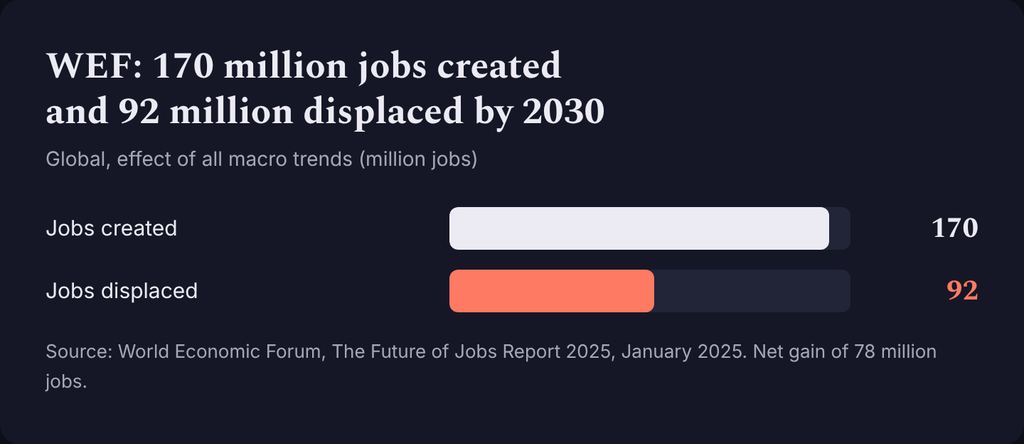
Figure 13 – WEF- 170 million jobs created and 92 million displaced by 2030
The real danger lies not in the size of the numbers but in the shape of the loss. Three reasons stand out:
- The bottom rung of the career ladder is breaking. White-collar professions renew themselves through a master–apprentice relationship. A company that stops hiring at entry level today will struggle, a decade from now, to find seasoned candidates to replace its senior staff. The age gap in Stanford’s data is the first sign of that rupture.
- A degree is no longer a shield. Microsoft’s findings suggest that jobs requiring a bachelor’s degree are more exposed; New York Fed data show that 42.5 per cent of recent graduates work in jobs that don’t require one. None of this proves that the return on a degree has fallen — there is no measure here of the wage premium. But it does show that a degree, on its own, is no guarantee.
- The statistics struggle to see this kind of unemployment. The freelance translator’s shrinking income, the underemployed graduate and the job that is never advertised do not register in the unemployment rate. White-collar unemployment is likely to show up not as joblessness in the open, but as deskilling and creeping precarity.
That is why the policy question for the years ahead should not only be how to shield blue-collar workers from cyclical shocks, but how to rebuild the white-collar apprenticeship system. Incentives for entry-level hiring, collective-bargaining clauses ensuring that AI-driven productivity gains find their way into wages, and — as the ILO stresses — reskilling programmes for women, who face greater AI risk, should sit at the centre of that agenda. Lifelong learning and career changes need to be actively encouraged. If a country can suddenly leave high and dry people who have reached forty with several degrees and hard-won expertise, and who are still yeeears away from retirement, then it needs to act urgently — and to study the risk of a major wave of unemployment in painstaking detail.
Conclusion: so why am I still learning languages?
At a time when translation is passing largely into the hands of machines, I was studying Sinology at Ankara University purely out of curiosity — until Celaleddin took my job and things got serious. Now, at 41, I am learning Chinese in earnest. On the face of it, this is like signing up as an apprentice at a diesel-car factory. In a few years, AI tools may make learning Chinese unnecessary altogether. If Frey and Llanos-Paredes are right, demand for foreign-language skills will go on falling.
But the data in this piece also underline a distinction. According to Stanford, AI shrinks employment in occupations where it automates tasks, while preserving or even expanding it in occupations where it complements the worker. Someone who learns a language in order to translate belongs to the first group. Someone who learns a language in order to understand it, to check the machine’s work, to supply context and to build trust with the person across the table is trying to join the second. I’m putting my money on the second. Whether the bet pays off, I’ll find out in a few years — most likely from the next Stanford update.
And this isn’t just about me. Every day I see some new AI anxiety around me.
My friends in data analytics have no choice: despite knowing that the “integrate AI into our processes, we need to cut costs” prompts coming down from their bosses will one day cost them their seats, they are digging their own graves.
A Gen-Z friend of mine, prompted by her boss, taught LLMs to do the job she had been doing for years at the fintech company where she worked — and guess what? Her seat was left empty. She had dug her own grave, yes — but, very much in tune with the zeitgeist, she had also learned to automate processes, and the company valued her quick adaptation so highly that it moved her to another department. Not everyone will be so lucky…
Zikriye, a character in a play I am writing, walks the same road: a woman who has lost her job, is struggling to make ends meet as a translator, and is looking for her future in Chinese. ChatIn, Celaleddin and Dimrit are her everyday tools, too. The point is not to run from these tools; it is to stand on the side that can do what they cannot. AI is reshaping our societies and economies at a frightening pace. Even so, just as after the arrival of the internet, I believe we have no choice but to climb aboard — and to trust that this wild but formidably clever tool will bring us closer to a more humane way of living. So when you have finished reading this, sit with the question for a while — and get to know at least one of ChatIn, Celaleddin and Dimrit.
ChatIn and Celaleddin were used in preparing this article. Research by Anthropic, the company that develops Celaleddin (Claude), is also cited as a source in this piece; I want readers to know that.
Updated: 22 November 2026
References
- Al Jazeera. Washington Post announces massive layoffs in blow to storied paper. 4 February 2026.
- Anthropic. Labor market impacts of AI: A new measure and early evidence. 5 March 2026.
- Axios, interview with Dario Amodei, May 2025; cited by Washington Monthly, How AI Broke the Entry-Level Job, 29 May 2026.
- Bloomberg HT. Geçen seneye göre beyaz yakada yüzde 32’lik bir düşüş görüyoruz. 10 October 2026.
- Brynjolfsson, E., Chandar, B. and Chen, R. Canaries in the Coal Mine? Six Facts about the Recent Employment Effects of Artificial Intelligence. Stanford Digital Economy Lab, August 2026 version; summary and update note, 12 August 2026; earlier versions: August 2025 (SIEPR), November 2025; February 2026 note.
- CBS News. AI emerges as a top cause of layoffs, May 2026; Remote work and young workers’ unemployment, 2026.
- CFO Dive. AI cited as top reason for US job cuts for third straight month. June 2026.
- Challenger, Gray & Christmas. Layoffs Fall, Hiring Picks Up; AI Leads For Fifth Straight Month. August 2026.
- Chip. ChatGPT’nin en pahalı aboneliği belli oldu: Türkiye fiyatı şaşırtıyor. October 2026; Teknoblog, ChatGPT Plus fiyatı ikiye katlandı.
- CNBC Select. Class of 2026 hiring stats and AI trends. 2026.
- Columbia Journalism Review. The Washington Post Gave Up on Diverse Coverage Well Before Layoffs, 16 February 2026; What the Post Cuts Will Do, 6 February 2026.
- CPA Practice Advisor. U.S. Companies Announce Fewest October Job Cuts in Three Years. 6 November 2026.
- Entrepreneur. Blue-Collar Careers Were Supposed to Be AI-Proof. So Why Is Hiring Down 40 Percent? 2026.
- Fortune. Microsoft research: generative AI occupational impact, 31 July 2025; Amazon layoffs, 28 October 2025; Skilled trade demand and the data center boom, 20 March 2026; AP buyouts, 6 April 2026; AI will kill the path to your first job, 29 April 2026.
- Frey, C. B. and Llanos-Paredes, P. Lost in translation: AI’s impact on translators and foreign language skills. VoxEU/CEPR, March 2025; Oxford Martin School working paper.
- Goldman Sachs. How Will AI Affect the Global Workforce? August 2025; How Will AI Affect the US Labor Market? March 2026; October 2026 update, cited by IBTimes.
- Gürcihan, B., Beyhan, B. and Akçomak, İ. S. Sabancı University, October 2026; cited by QUASA.
- HCAMag. AI blamed for 121,401 job cuts, but the labor data isn’t buying it. November 2026.
- IBISWorld. More Degrees, Tougher Odds. 2026.
- ILO. Generative AI and Jobs: A Refined Global Index of Occupational Exposure. Working Paper 140, 2025; New ILO data confirm women face higher workplace risks from generative AI, 5 March 2026.
- İŞKUR. Labour Market Survey 2025; cited by Politikam.
- NBC News. Washington Post layoffs. 4 February 2026.
- New York Fed. The Labor Market for Recent College Graduates; press release, 28 May 2026; cited by Finger Lakes 1, 10 November 2026; Fortune, 26 October 2026.
- Nieman Lab / PR Newswire. Media News Recap for March 2026; Washingtonian, cited by Nieman Lab.
- NPR Planet Money. If AI is so good, why are there still so many jobs for translators? 18 June 2024.
- Reuters, cited by bdnews24. Amazon axes 16,000 jobs as it pushes AI and efficiency. 28 January 2026.
- Society of Authors survey, cited by The Next Web, 18 April 2024; The Bookseller; European Writers’ Council.
- Tech Policy Press. Cutting Local Journalists, McClatchy Embraces AI Content. 8 October 2026.
- TheStreet Pro. Job cuts hit 4-year low, October 2026; October job cuts at 3-year low, 5 November 2026.
- Trading Economics. US Job Cuts Hit a Three-Year Low for October. 5 November 2026.
- Washington Times. Washington Post lays off one-third of workforce. 4 February 2026.
- World Economic Forum. The Future of Jobs Report 2025. January 2025.
- Yale Budget Lab. What we do and don’t know about how AI is affecting the labor market. 2026.







